
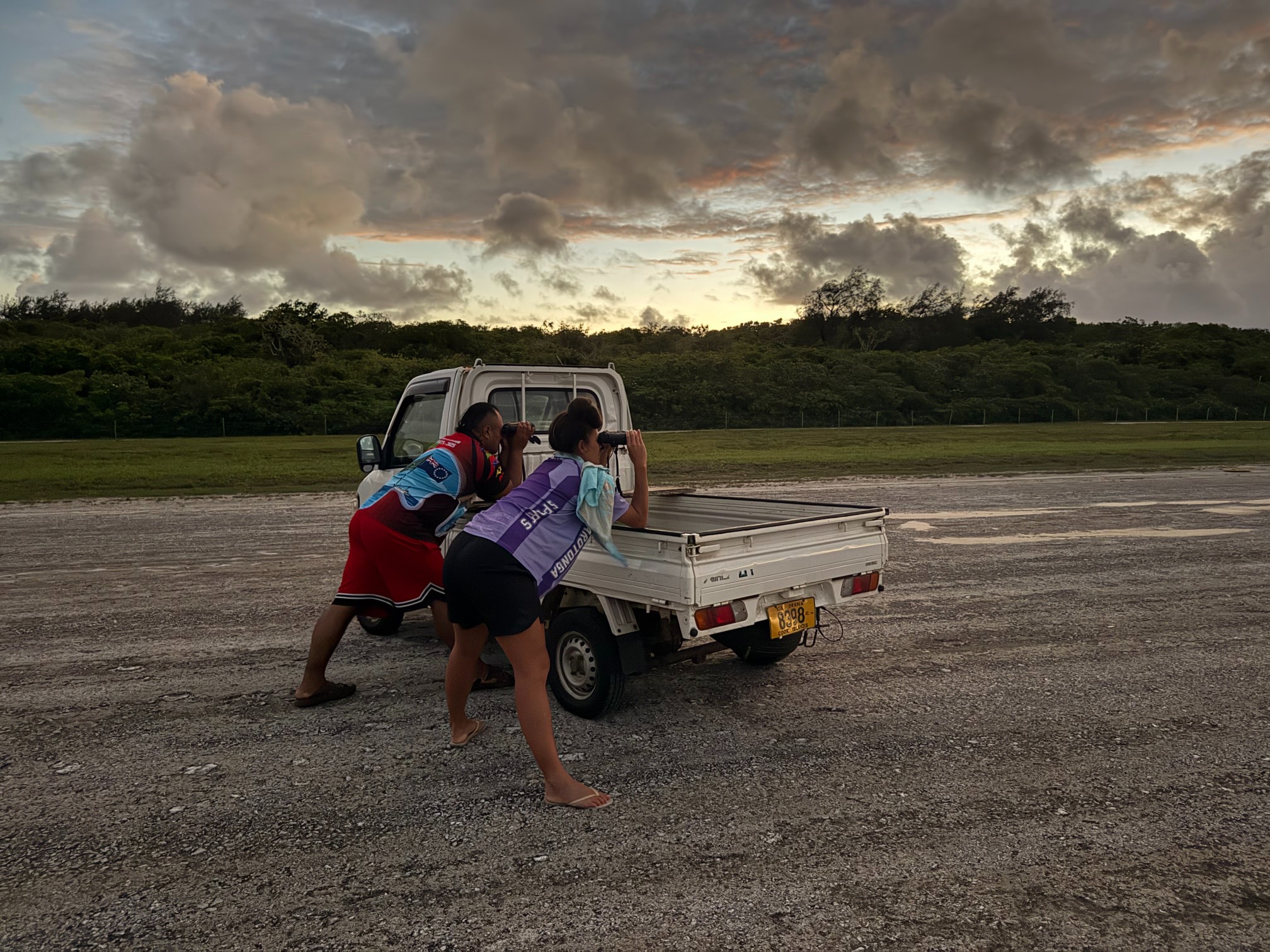
Seabird monitoring efforts for species we rarely see continued this year on the land of the birds, Enuamanu, Atiu. The main focus of these efforts are the petrels and shearwaters, with the local Atiu name for shearwaters being Titi Rakorakoa. Many of these species are often difficult to study because they spend most of the day far out at sea, only returning to their nesting colonies on land after dark. Their presence is usually detected not by sight, but by the distinctive calls they make shortly after nightfall and again during the early hours of the morning.
To carry out this survey, a collective multi-agency field team was formed, including representatives from Te Ipukarea Society, Archipelago Research and Conservation, the National Environment Service, and the Atiu Island Government. This collaborative approach brought together local knowledge, conservation leadership, and technical expertise to support the long-term goal of better understanding Atiu’s seabird populations.
The main objective for the field team was to deploy three autonomous recording devices, known as “song meters”, in areas likely to be used for nesting by the petrels and shearwaters. These devices will remain in place for a full year, and record on a set cycle during periods the seabirds are most likely to be active. This way we will be able to assess which of these seabirds are still present on Enuamanu. The three survey sites were carefully selected following habitat assessments and local guidance. These potential nesting sites included a cliff area above Lake Ngatiaroa, a makatea site in Areora, and another cliff area known as Kue’kue (Mokoero). Most petrels and shearwaters typically nest in underground burrows in soft soil, beneath thick tangle fern cover, or within crevices in the makatea and limestone cliff walls. These habitats, particularly the vertical cliff faces, offer some protection from introduced predators such as cats, dogs, pigs or rats.
One of the most valuable tools for identifying these species is their unique vocalisations. Each species produces distinctive calls, enabling researchers to differentiate them from one another, even when the birds themselves remain out of sight. Sample calls were shared amongst the community, and it became clear that the Titi Rakorakoa, Tropical Shearwater was the species remembered by older Atiu residents as being common in past decades. Titi Rakorakoa produce an array of sounds described as rapid crows, howls, cackles, trills, and even moan like cries reminiscent of a baby. Community members recalled that shearwaters were once abundant, particularly before the widespread development of the pineapple industry. At that time, Atiu also had extensive tangle fern habitat, which would have been favoured for nesting sites for other petrel species as well.
A targeted night survey using thermal binoculars was also conducted over the open area of the Atiu airport runway. This resulted in a single Tropical Shearwater flying overhead at around 8:30 pm. This was a really promising sign that small numbers of this species may still be nesting on Atiu. Small remnant populations may still exist, nesting deep within the raised cliff areas or in remote makatea areas where access is difficult and where natural barriers offer some protection from predators such as pigs, cats, dogs, and rats.
A big meitaki ranuinui goes to field assistants Enua Wichman and Joshua Jim for their invaluable support to the visiting team from Te Ipukarea Society and Archipelago Research and Conservation.

This project is proudly funded by the National Fish and Wildlife Foundation, whose support is helping to strengthen conservation knowledge and seabird protection efforts in the Cook Islands.