
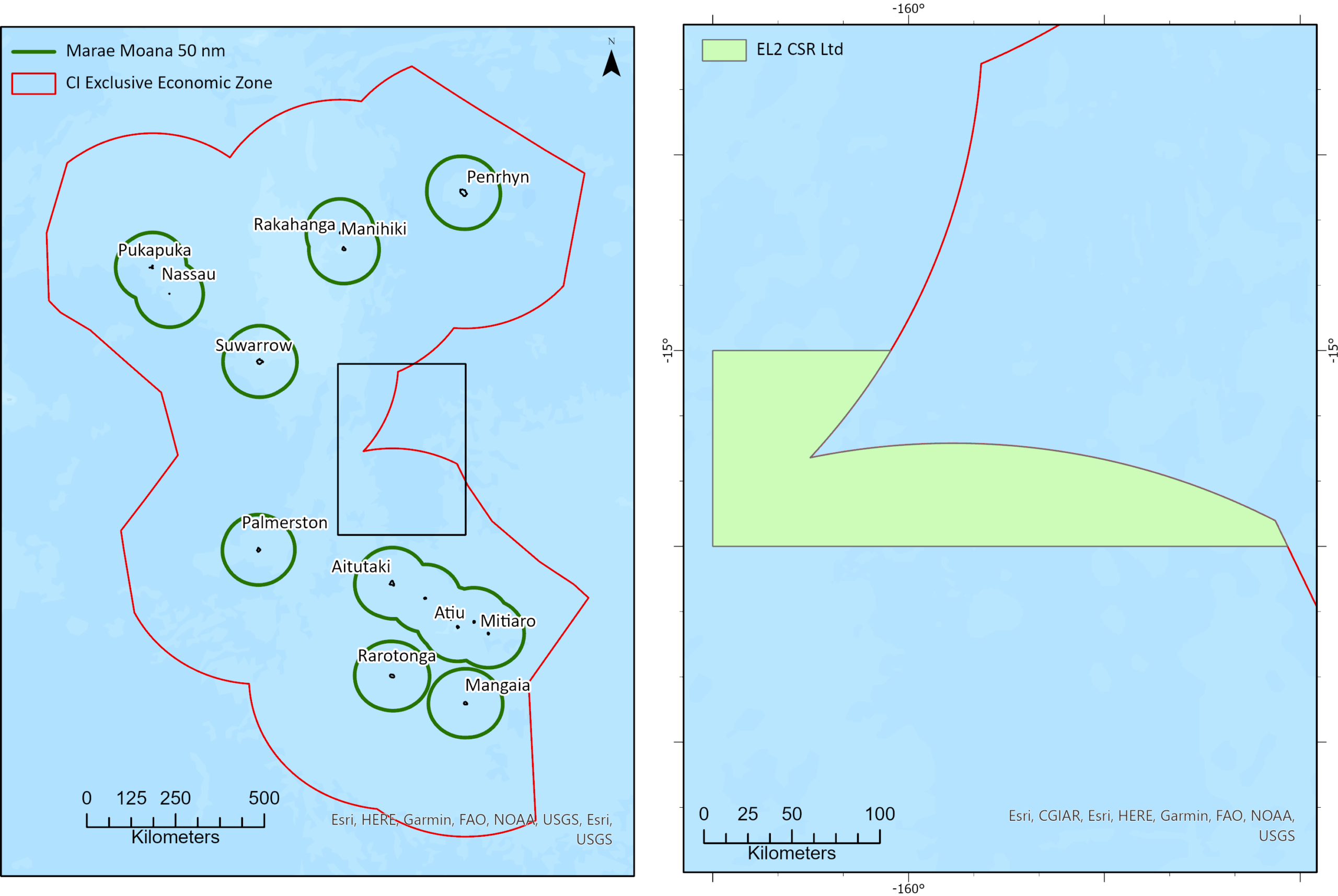
Several months ago, rumours were circulating at the International Seabed Authority meeting in Jamaica that Belgian company, Global Seabed Resources (GSR), intended to sell its share of the joint venture company Cobalt Seabed Resources (CSR) to mine polymetallic nodules in the Cook Islands. This was subsequently confirmed during a meeting between Te Ipukarea Society and the Seabed Minerals Authority (SBMA).
Based on this, we submitted a request to the Cook Islands Investment Corporation (CIIC) under the Official Information Act, asking to whom these shares were being sold. The CIIC did not disclose the buyer, citing commercial sensitivity. However, they did confirm that while GSR is divesting its interests in the Cook Islands, the company is retaining its partnership with the Cook Islands Government for potential mining ventures in the Clarion-Clipperton Zone (CCZ) international waters.
We also asked the CIIC why GSR was selling their Cook Islands interests. They directed us to ask GSR directly, which we did. GSR have responded via a press release and an email, basically saying they will be focussing on the joint venture work in the CCZ, as “they can’t be everywhere at once”. They also did not disclose the names of any potential buyers for their interests within the Cook Islands.
One rumoured potential buyer for a share in the Cook Islands joint venture is a company called Wetstone. This appears to be a very new entity, formed in 2024. Currently, it has a single-page website offering no information other than an email address and a tagline describing it as a “global offshore critical mineral exploration & development company.” They were formally known as the Seabed Minerals Fund.
We reached out to the contact provided on the Wetstone website to verify the rumours of their interest but have so far received no reply. Preliminary research suggests the company has only a handful employees and lacks a track record of technical capacity or environmental stewardship, appearing to be primarily an investment vehicle. This raises crucial questions regarding their credibility and credentials to be a “fit and proper” entity to partner with our government to undertake serious exploration of our seabed, let alone trying to mine it. We trust this is an unsubstantiated rumour.
Though not stated, the GSR decision to divest their interest in Cook Islands waters may also relate to economic viability and technical challenges. Mining nodules from a depth of 5,000 meters is an incredibly expensive undertaking. To offset these costs, miners must target the most valuable resources. Not all nodules are created equal. Nodules in the Clarion-Clipperton Zone (CCZ) are estimated to be worth approximately 50% more per mt than those found in the Cook Islands, based on an analysis of the percentage and value of the minerals they each contain.
Another advantage of nodules from the CCZ is that they are relatively rich in nickel, copper, and manganese, but lower in iron. They are chemically similar to terrestrial ores, making them more straightforward to process. Cook Islands nodules are iron-rich and have more titanium than those in the CCZ. They are also lower in manganese. Processing is inefficient because the high iron content dilutes the alloy, and the valuable titanium is lost in the runoff. This necessitates a chemical “leaching” approach, which is more complex.
Beyond economics, there are also ethical and geopolitical considerations based on the question of end use. The primary value of Cook Islands nodules lies in their high cobalt content. While cobalt is currently used in electric vehicle batteries, that industry is rapidly shifting toward chemistries like Lithium Iron Phosphate (LFP), which are cobalt-free. This shift potentially lowers the long-term value of the Cook Islands’ primary resource. However, while they may become less important for battery technology, deep seabed minerals also have significant military applications. Alloys using nickel, titanium, and cobalt are highly sought after for defence manufacturing. Is the very recent interest by China and the United States in our deep sea mineral sector related to this?
In September of this year, our Prime Minister, alongside other Pacific Island leaders, endorsed the “Ocean of Peace” declaration during the Leaders meeting in Honiara. This serves as a vital reminder that the Pacific must always remain a zone of peace. It would be highly unethical and hypocritical for the Cook Islands to allow mining of minerals in our waters which will be used for military purposes.
In light of our commitment to a peaceful Pacific, we would suggest that GSR do not need to be replaced. And although the 5-year extension on mining exploration licences sounds good, we believe, it would be more responsible for the Cook Islands to join the global call for a moratorium.