
why the Cook Islands is building a supply chain for a decision it claims not to have made
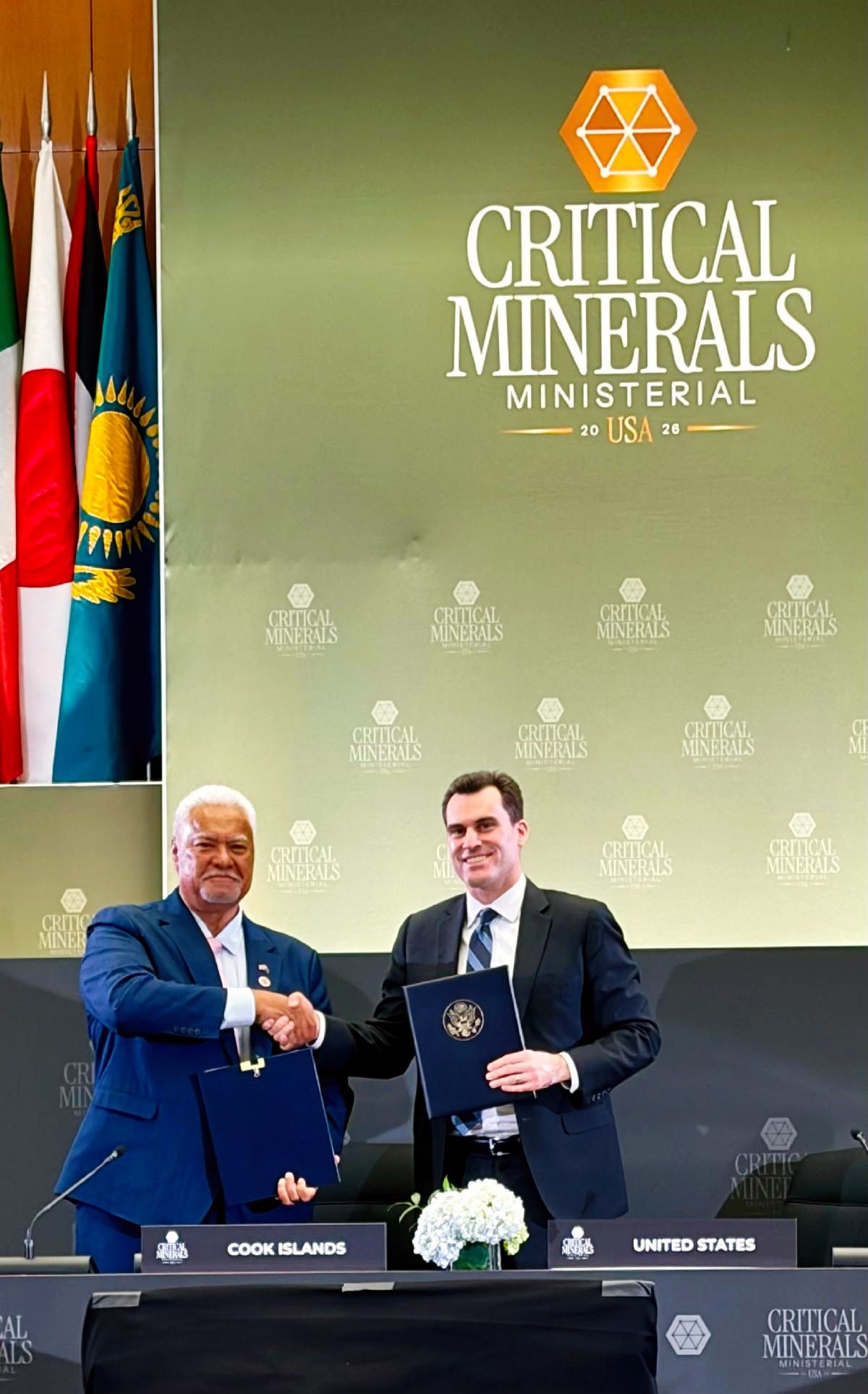
The recent signing of the Strategic Framework for Critical Minerals Research and Supply Chain Security between the United States and the Cook Islands raises some questions around the integrity of the Cook Islands Government’s position on deep seabed mining. At the heart of the matter lies a profound contradiction between the Cook Islands Government’s official rhetoric and its recent diplomatic arrangements. For years, Prime Minister Mark Brown and the Seabed Minerals Authority have maintained a public posture of cautious neutrality, asserting that “no final decision has been made on whether to proceed with commercial deep-sea mining”. They insist that the nation is strictly in an exploration phase, dedicated to gathering environmental baseline data to allow for a decision, on whether to mine or not, to be made.
Despite the SBMA press release of 4 February 2026, stating that the US framework does not commit the Cook Islands to extraction, production, or timelines, the new agreement actually suggests something else. It appears to be paving the way for mining, even though scientists are still advising caution and much more independent research. By formalising an agreement centered on "supply chain security," the Cook Islands is engaging in the logistical and geopolitical architecture of an active mining industry. Why do we need to secure a supply chain for the US for a resource we haven't yet decided to extract? This alignment suggests that the government is already moving past the "if" and onto the "how," effectively building the industrial plumbing for a deep-sea minerals market while still publicly debating the environmental cost of turning on the tap.
This discrepancy effectively creates a "momentum trap." When a small island nation enters into strategic frameworks with global superpowers like the United States, or its previous 2025 agreement with China, it generates significant diplomatic and economic expectation. These agreements often involve investment facilitation and technical integration that signal to the international market that the Cook Islands is "open for business." For environmental advocates and local community leaders, this looks less like a cautious scientific enquiry and more like the decision has been made. The fear is that by the time the scientific "exploration" is complete in 2027, or 2032 if the full 5 year extensions to exploration licences are utilised, the political and financial stakes will be so high that saying "no" to mining would be an impossibility.
Furthermore, the involvement of US and Chinese interests introduces a competitive element that may compromise the rigorous environmental standards the Cook Islands Government claims to uphold. As these superpowers jostle for dominance in the green energy transition, our polymetallic nodules become pawns in a larger geopolitical game. While the government maintains that its "Marae Moana" conservation laws will always take precedence, the language of the US framework focuses heavily on their own.their own resilience and strategic goals for national security and industrial competition.
Our Government appears to be playing both sides. Locally, they tell the people, especially through their consultations with the people living in the Pa Enua, that nothing is set in stone, which helps them convince the communities that the Cook Islands will not allow mining unless environmental standards that do not damage our marine ecosystems can be met. Meanwhile, internationally, they are signing agreements that put them at the heart of the global minerals market. These deals push the country in one direction: toward mining. With every new agreement, the potential to choose a different path decreases, regardless of whether the science says it’s safe.
Photo: Sonny Williams, Assistant to the Minister Responsible for the Prime Minister, with his United States counterpart after agreeing a non-binding Framework for Engagement and Cooperation to strengthen supply chains for critical minerals and rare earths, including cooperation relating to deep-sea minerals.(SuppliedbySBMA)