Strengthening Pacific turtle knowledge
The South Pacific is home to a number of migratory sea turtle species, including green and hawksbill turtles found in the Cook Islands. Their long-distance movements between nesting beaches and feeding grounds connect island nations and marine ecosystems across the Pacific Ocean.
Despite their importance, significant knowledge gaps remain around turtle connectivity in the South Pacific, let alone within the Cook Islands. For instance, do our turtles that nest in the northern Cook Islands make their way to the southern Cook Islands?
To help address these gaps, regional tools for collecting and sharing turtle monitoring data have been developed and improved over time.
Recently, representatives from the National Environment Service, the Ministry of Marine Resources, and Te Ipukarea Society attended a turtle monitoring training programme coordinated by SPREP, Pacific BioScapes Programme.
The three-day training brought together participants from Fiji, Cook Islands, and Kiribati to one of Fiji’s off shore islands ,‘South Seas Island’, for hands on turtle monitoring training. It focused on flipper tagging options used to track turtle movements. Flipper tagging is a cost effective method which involves attaching a small lightweight metal to a turtles front flipper. Each tag has a unique identification number allowing that individual turtle to be recognised if it is encountered again. Participants were trained in how to safely apply flipper tags and practised clipping the tags to a cardboard model.
Genetic sampling was also discussed. This method is used to better understand turtle population connectivity. Participants practised using a biopsy punch on starfruit to simulate the collection of a very small muscle sample, typically taken from the turtle’s neck area.
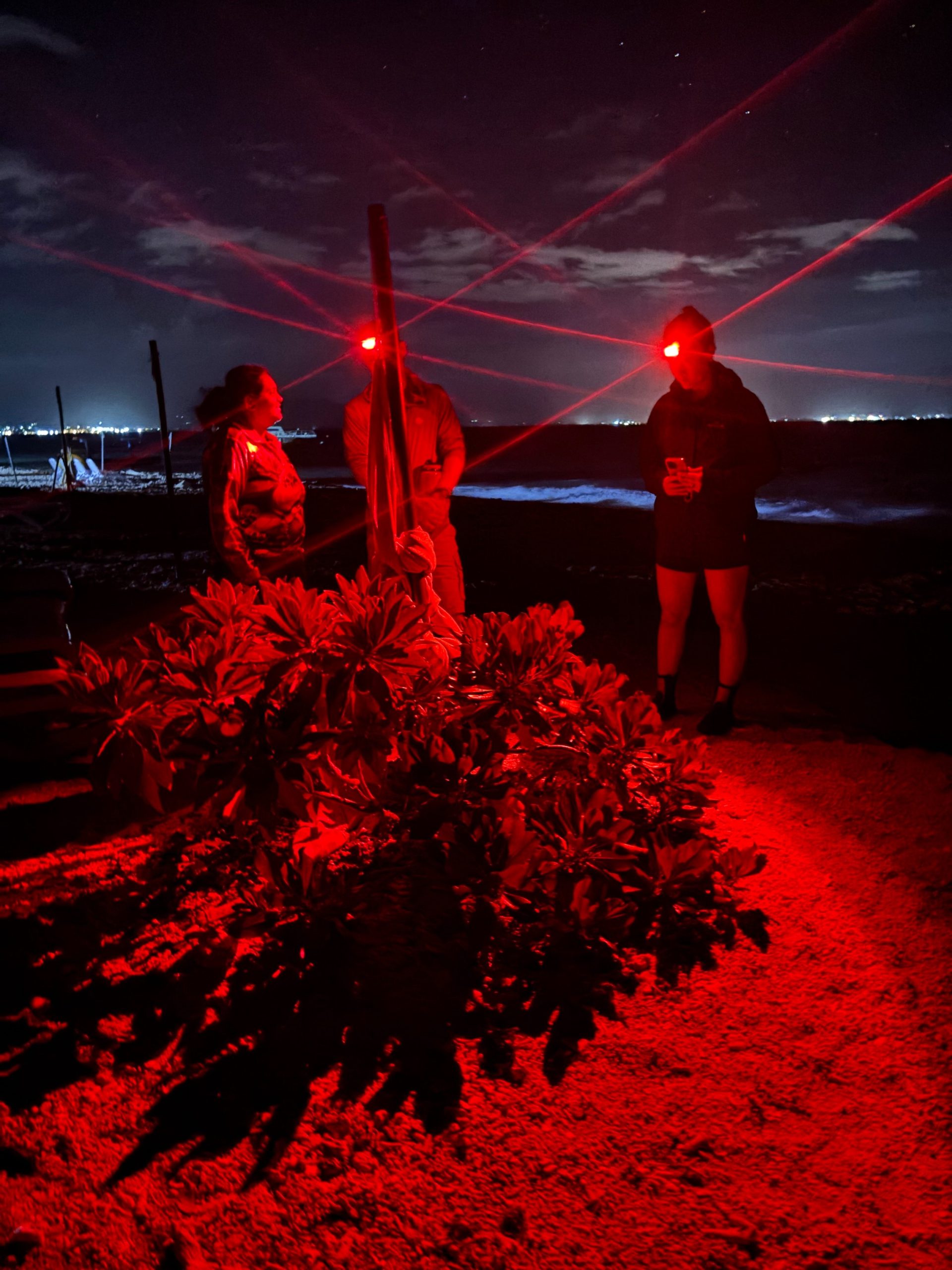
Night surveys were conducted from 8.00 pm to midnight in an effort to observe nesting activity, with teams monitoring beaches for females coming ashore to select nesting sites. Although no nesting events were observed, the surveys provided valuable insights into preferred nesting habitats. These included darker sections of coastline with reduced artificial lighting and areas with coastal vegetation such as Tauʻunu (Heliotropium arboreum), which is favoured by nesting hawksbill turtles.
Daytime sessions introduced participants to TREDS (Turtle Research and Monitoring Database System), a regional platform designed to support the collection, storage, and sharing of sea turtle data. TREDS is used by government agencies, NGOs, researchers, and community monitoring programmes to record nesting activity, tagging and recapture data, and individual turtle measurements and health observations.
Overall, participants expressed strong interest in expanding genetic sampling on their home islands to better understand national and regional connectivity. The Cook Islands delegation also discussed opportunities for satellite tagging to track individual turtle movements. While satellite tagging is more costly than Te Ipukarea Society’s current citizen science photo-identification programme, which uses the unique facial patterns of turtles, it provides real-time insights into turtle movements and behaviour and helps identify critical feeding, breeding, and nesting habitats.
Understanding and learning more about our sea turtle population is important because of the key role turtles play in maintaining healthy marine ecosystems. Green turtles help support carbon storage. Hawksbill turtles control sponge growth on coral reefs, allowing corals to thrive, while leatherback turtles help regulate jellyfish populations, contributing to balanced open ocean food webs. Overall, through their extensive migrations, sea turtles also transport nutrients between habitats, strengthening the resilience of marine ecosystems across the Pacific.