Earlier in November, Dr Katie Bird and I had the privilege of representing Te Are Manu on a remarkable veterinary outreach trek to two of our Northern Group Pa Enua—Pukapuka and Penrhyn. This trip was made possible through the New Zealand High Commission Grand and partnership with Te Ipukarea Society (TIS) and Kōrero o te ‘Ōrau (KO).
Our goals were to better understand the animal health needs of the Northern Pa Enua, provide desexing services for local cat populations, and address pig health to support long-term food sustainability. But what unfolded over the course of our journey was much more than a clinical outreach, it was an experience defined by community connection, shared learning, and genuine hospitality.
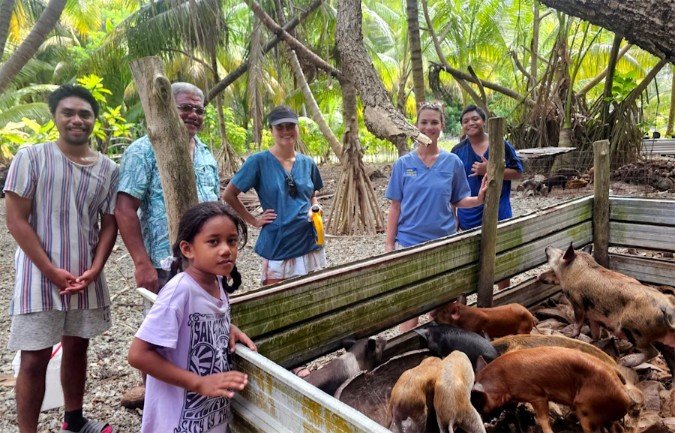
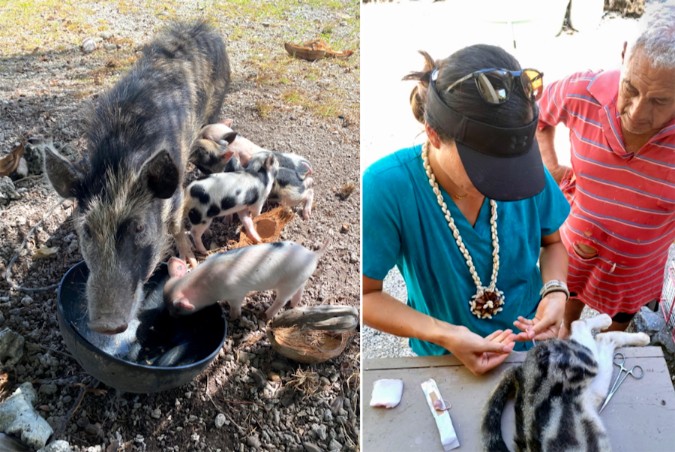
Upon arriving on each island, we received a warm welcome from the Island Council representatives who had worked to organise accommodation, transport, and suitable workspaces for our teams. Over the days that followed, we assessed a wide range of animal health concerns, carried out desexing procedures, and worked closely with local families to support the wellbeing of their animals.
Pig health was a particular focus, given the importance of pigs for food security in such remote circumstances. Many households shared their experiences and some challenges with raising pigs, and it was fantastic to see the level of care and resourcefulness already present in these communities.
Education was another key part of our mission. Alongside TIS and KO who delivered presentations on ocean health, we delivered short community presentations on animal health and welfare. One of the highlights of the trip was visiting the schools, where we spoke with students about caring for animals, preventing disease, and the range of career pathways available in the animal health field. The enthusiasm from the students was infectious, and many asked thoughtful questions that showed a real interest in science, the environment, and their own futures. These conversations left us hopeful for the next generation of Cook Islands animal advocates.
One of the most meaningful aspects of this project was the way multiple NGOs came together with a shared purpose. In the Cook Islands, where resources are often stretched and logistics are complex, combining our strengths allowed us to achieve far more than any one organisation could have done alone. Te Are Manu, TIS, and KO each brought unique expertise, from animal health to environmental stewardship to youth engagement, which created a diverse approach to supporting the Pa Enua on this trip.
A project of this scale cannot happen without strong support behind the scenes. We extend our heartfelt thanks to the New Zealand High Commission, whose grant funding allowed the clinics and travel logistics to become a reality. A special acknowledgment goes to Te Ipukarea Society for coordinating the charter flight and so many of the complex arrangements both before and during the trip.
Most importantly, we thank the communities and Island Councils of Pukapuka and Penrhyn for embracing our team and the work we brought with us. The generosity, hospitality, and open-hearted nature of each island made us feel not only welcome but deeply connected to the community. Every conversation, every shared meal, and every story reminded us why outreach work is so meaningful.
We return to Rarotonga grateful and proud of what we collectively achieved. It was a privilege to bring Te Are Manu’s services to the Northern Pa Enua, and we hope to be back again soon to continue supporting the health and wellbeing of animals, and the communities who care for them.
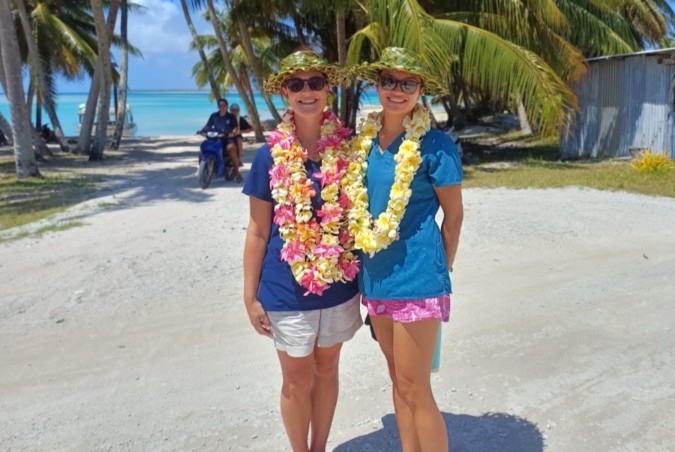
Image supplied: Australian veterinarian Dr Rose Hasegawa and Dr Katie Bird were in Pukapuka and Penrhyn in the Northern Group.