
Te Manu Tai o te Kūki ʻĀirani - Mangaia
A song-meter service in Mangaia last week marked the start of this year’s work for the Te Manu Tai o te Kūki ʻĀirani project, focused on better understanding Cook Islands petrel and shearwater populations.
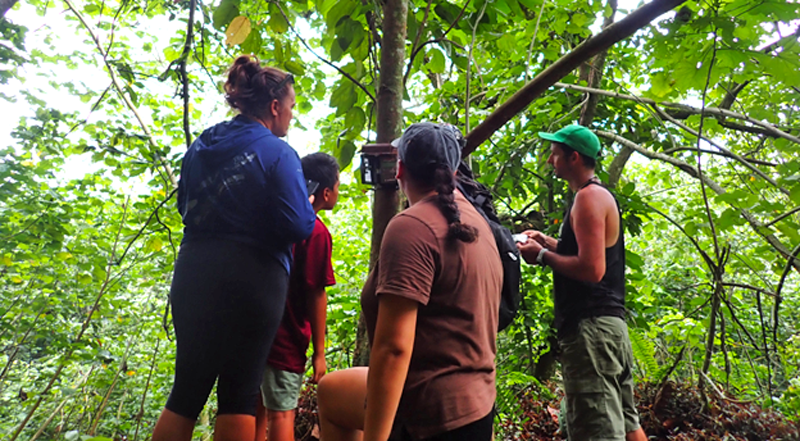
The trip on Mangaia involved servicing seabird “song meters”, which are sound recorders that capture audio from sunset to sunrise. Similar devices have also been placed across Atiu and the main peaks of Rarotonga as part of the wider project. By analysing the distinctive calls recorded overnight, we can identify which seabird species are present and where. The team is excited to begin processing the data and to gain preliminary insights into what petrel and shearwater seabirds are calling Mangaia home.
Mangaia’s unique geology provides a range of environments well suited to petrels and shearwaters, including rugged coastal makatea, elevated terraces and steep inland cliffs. These rocky and often inaccessible areas are particularly attractive to petrels and shearwaters (tubenoses), which prefer to nest in burrows, crevices or cliff faces away from human disturbance. Tubenoses spend their days out at sea feeding, only returning at night to their nests, making them elusive and difficult to monitor, which is why song meters are so valuable for detecting their presence.
Seabirds play a vital role in island environments, serving as a crucial link between ocean and land. By bringing nutrients from the sea back to their nesting sites, they naturally fertilise coastal and inland areas, supporting plant growth and a range of ecosystems to thrive. However, the presence of predators such as pigs, cats and goats, which are prevalent throughout Mangaia, may have impacted seabird populations by disturbing nesting sites and degrading habitat.
The field team, Brennan Panzerella, Kas Silk (National Environment Service officer) and Gemma Langley (Volunteer Service Abroad volunteer), were joined by local NES officer Tangimama Harry and her family to service Mangaia’s three song meters. These devices were originally installed in August last year in potential seabird habitat sites by Alanna Smith (TIS) and seabird expert Dr André Raine from Archipelago Research and Conservation (ARC). From the August survey the field team, with Apii Mangaia School Principal Michael Papatua, were able to identify a pair of tropical shearwaters flying at nighttime around Te Pa‘ata look out. The local Mangaian name for this shearwater is said to be the Rākoa, in Atiu it is called the Titi Rakorakoa. Mangaia’s song meters were placed strategically across Mangaia’s inland terraces, cliffs, and coastal makatea to capture seabird activity in a variety of environments.
A motion-sensor field camera was also installed in August within the rugged coastal makatea to monitor predators and seabird activity. When the team revisited the camera, they found it had sustained significant damage. Analysis of the images revealed the presence of rats, a cat and a goat in the makatea environment, as well as a claw of an Unga Pukuʻara (coconut crab), likely responsible for the damage. The incident highlights that even robust field equipment can be vulnerable in these rugged environments, but it also shows the durability of the devices, as the camera was repaired and can now be put back into operation to continue collecting valuable data.
The team would like to thank Tangimama Harry whose knowledge of the island was vital in guiding the team along local tracks and advising on potential song meter placements. The team also acknowledges the Mangaian community for their hospitality.
Te Manu Tai o te Kūki ʻĀirani project is locally led by Te Ipukarea Society in collaboration with Archipelago Research and Conservation and the National Environment Service. Funded by the National Fish and Wildlife Foundation and supported by SPREP, Island Conservation, Northern NZ Seabird Trust and BirdLife International Pacific.