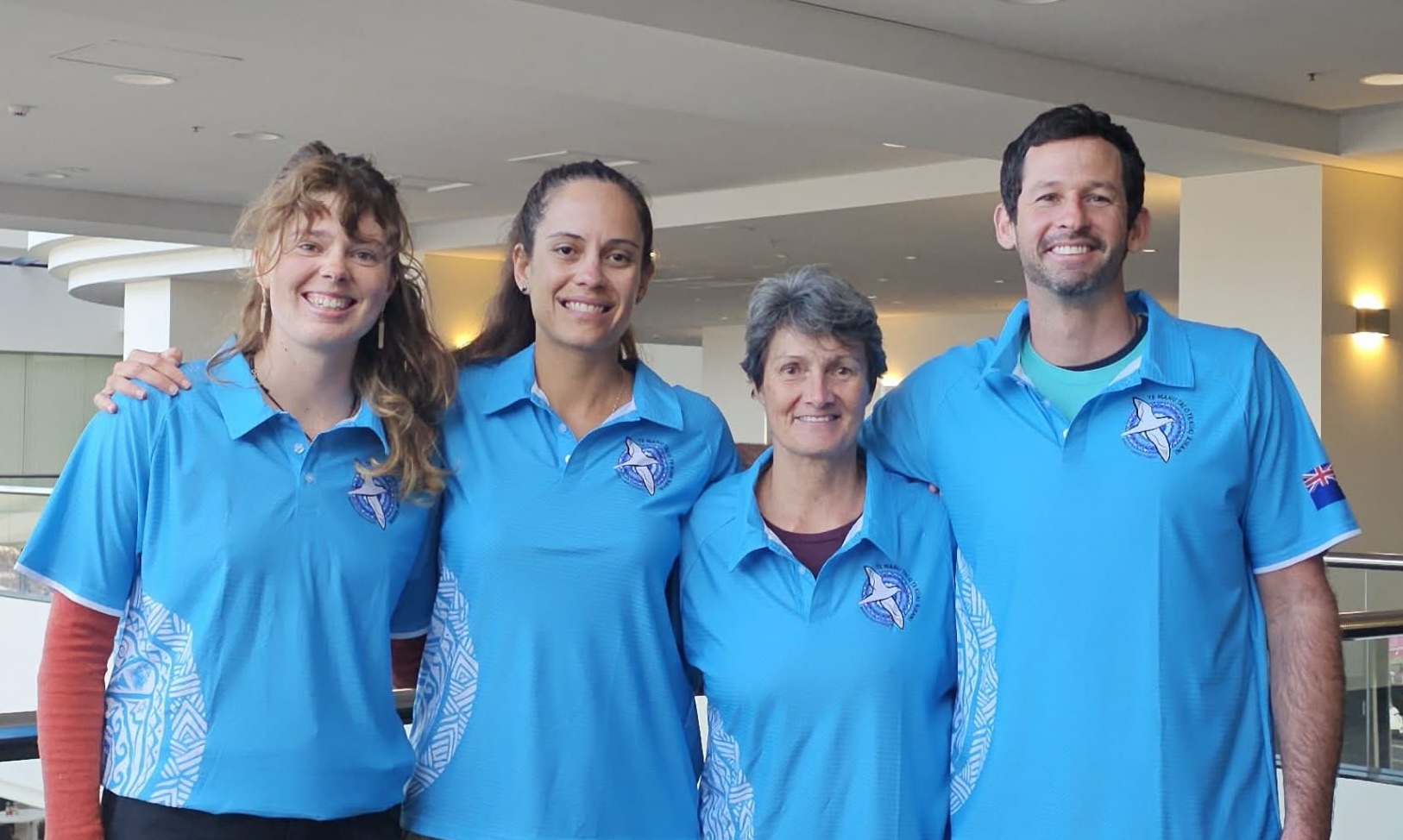
Photo: The Cook Islands team at the 4th World Seabird Conference – Jemma, Alanna, Kas and Brennan
Representatives from our local Cook Islands seabird monitoring team, including representatives from Te Ipukarea Society (Alanna Smith and Brennan Panzarella), The National Environment Service (Kas Silk) and New Zealand Volunteer Service Abroad (Gemma Langley), recently had the opportunity to attend the 4th World Seabird Conference. Held every five years, the conference brings together researchers, conservation organisations, governments and policymakers from around the world to share knowledge and discuss ways to protect seabirds and the oceans they depend on.
There were many important topics discussed, including seabird biology, monitoring for nesting populations and translocation case studies of seabirds being moved from their original nesting sites, threatened by sea-level rise, to higher elevated areas.
One topic that caught the attention of the Cook Islands team was the discussions on restoration efforts carried out on atoll islands, particularly for uninhabited atolls that are hotspots for nesting seabirds ie Takutea, Manuae, Suwarrow.
The Cook Islands has already been involved in a number of seabird and island restoration efforts, such as rat eradication projects on our uninhabited atolls and Palmerston Island. Research has found that rat free islands result in not only increased seabird numbers and enhanced native flora, but benefits that extend beyond the islands themselves.
As seabird populations recover, increased seabird numbers result in more nutrients being transported from the ocean onto islands through their guano, or droppings. These nutrients can then enter the surrounding marine ecosystem, contributing to increased productivity of coral reefs, including an increase in reef fish communities.
Another restoration approach that was discussed and has been trialled in parts of the Pacific is the removal of coconut palms from atoll islands.
For many Pacific people, this might initially sound like a crazy idea. The coconut is often described as the “tree of life” and has provided food, materials and livelihoods for generations. So why would conservationists want to remove it?
The issue resides with atolls that are densely dominated by coconut trees, reducing the diversity of native vegetation and therefore the availability of suitable nesting habitat for seabirds.
Many seabirds that nest in trees, such as Red-Footed Boobies (Toroā) and Frigatebirds (Kotaʻa), prefer large native broadleaf trees with suitable branches for nesting. Coconut palms have a very different structure and are not suitable nesting trees for these larger seabird species.
This raises another important question for Pacific islands: if we remove the coconuts, what will the coconut crabs eat?
Despite their name, coconut crabs do not rely exclusively on coconuts. They are opportunistic omnivores and scavengers, eating a variety of plant and animal material, including decaying vegetation, wood, animal remains and other invertebrates.
Alternative options to simply removing every coconut tree could include, restoring native forest in areas where nesting seabird numbers are high while retaining some coconut palms in areas that are less important for nesting. This could help balance the needs of seabirds, coconut crabs and people who may utilise these sites as a sustainable ‘food cupboard’ source.
The key lessons from the World Seabird Conference was that island seabirds are not simply species which aid in island protection through their rich guano, but are also key indicators of the health and changes occurring throughout marine ecosystems. Their survival depends on what happens both at their breeding sites and across the huge areas of ocean where they feed. Climate change, changing ocean conditions, fisheries, pollution, disease, potential new threats like deep-seabed mining are all interconnected to affecting seabird numbers and their distribution. This was a central theme throughout the conference, with researchers, governments and conservation organisations sharing practical approaches to reducing these threats, strengthening monitoring, and improving management and enforcement, particularly around fisheries.
For the Cook Islands, the message was clear: protecting our seabirds means looking after both the islands where they breed and the ocean that sustains them, while also strengthening our understanding of the seabirds that call these islands home, including which species are still nesting here, where they are found, and the local names, knowledge and cultural connections associated with them.