

Print – Ocean Health / Deep-seabed mining / Educational
Activity guides to support learning about our Oceans

Treasures of the Deep – Story Plus Activity Guide
Treasures of the Deep was written with education in mind, so its Activity Guide is packed with activities that will help educators (whether at home or school) draw out some of the ideas and themes within the story. Many of the activities can be done individually, though most will be more fun and interesting when done with others.
Click here to access a downloadable PDF with electronic links.
NB: There is a limited supply of books in English and Cook Islands Māori available in NZ and Rarotonga. If interested please email edna4tis@gmail.com

Unbroken – Story Plus Activity Guide
Unbroken was written with education in mind, so its Activity Guide will help educators (whether at home or school) extend the considerations and help develop a deeper understanding of the messages in the book. The activities are aimed at High School level thinking and understanding and cover a range of areas, eg research, language, and creative arts.
Click here to access a downloadable PDF with links.
NB: There is a limited supply of books in English and Cook Islands Māori available in NZ and Rarotonga. If interested please email edna4tis@gmail.com
Deep-seabed mining posters / flyers

Deep-seabed mining poster – Māori

Deep-seabed mining poster – English
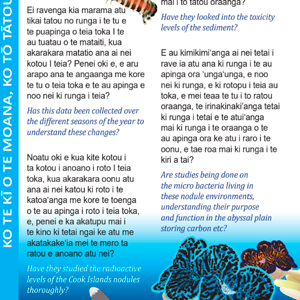
Questions to ask / consider – Māori and English

One Biblical thought- Māori
Watch – Ocean Health / Deep Sea Mining
Videos on deep-seabed mining (DSM)
Deep Conversations
This video provides some local opinions on deep seabed mining in the Cook Islands. This was filmed before the exploration phase had begun, but still provides interesting insights to ponder.
Click here to watch the video.
Deep Sea Mining Exploration Phase Cook Islands
Dive into deep conversations with the pa enua (outer island) community, NGOs and licensed mining companies on the current exploration phase and environmental risks of deep sea mining
Click here to watch the video.
Other videos
Mining the deep sea offers green energy potential but environmental risk” by Scripps News
Professor Chris Fleming discusses economic risks associated with a commercial deep sea mining industry by Cook Islands Television
Deep sea mining with John Oliver
Short deep-seabed mining (DSM) ads

Vaka on the rocks
This video is a play on an image showing a vaka sitting on rocks with no water. It highlights that the ocean and land are interconnected.
Click here to watch the video.

Don’t gamble away our future
This video highlights a few of the reasons we need to call for a pause or a moratorium on DSM. We just don’t have enough information yet.
Click here to watch the video.
Deep-seabed mining risks reels

24/7 noise from mining will impact whales

Mid water discharge of toxic fine sediment

Trials as far back as 50 years show no signs of recovery

Turbidity risks from plumes

Toxic seafloor plumes will travel and smother.

Noise from mining will disturb all ocean life living in the dark and dependent on sound communication

Plumes will smother the phyto- and zooplankton critical to human life

Nodules have a purpose in creations design, eg oxygen and habitat
Read – Ocean Health / Deep Sea Mining
A few quick references
Written articles
Life on the rocks” by Te Ipukarea Society
Deep divisions at the international seabed authority assembly” by Te Ipukarea Society
Social license for deep sea mining – letter to the editor” by June Hosking
Local community rallies against deep sea mining” by Te Ipukarea Society
Sisters dont always agree” by Te Ipukarea Society
Deep Sea Mining Demystified” by Rachel Reeves
Deep ocean groundings” by Rachel Reeves
Deep Sea Minerals Project

SPC EU Deep Sea Minerals Project
The Deep Sea Minerals Project is a collaboration between the Pacific Community (SPC) and the European Union (EU).
Initiated in 2011, the €4.4 million DSM Project is helping Pacific Island countries to improve the governance and management of their deep-sea minerals resources in accordance with international law, with particular attention to the protection of the marine environment and securing equitable financial arrangements for Pacific Island countries and their people.
The DSM Project has 15 member Pacific Island Countries: the Cook Islands, Federated States of Micronesia, Fiji, Kiribati, Marshall Islands, Nauru, Niue, Palau, Papua New Guinea, Samoa, Solomon Islands, Timor Leste, Tonga, Tuvalu and Vanuatu.
Click here to find out more about this project..
Likeminded local groups

Cook Islands Voyaging Society
The Cook Islands Voyaging Society Inc (the Society) is a non-profit organisation established in 1992 after the 6th Pacific Arts Festival held on Rarotonga, Cook Islands. Their vision is “To promote voyaging and thereby recognise and preserve our cultural ancestry; protect and conserve our oceans, lagoons, marine parks and waterways; contribute to a sustainable environment; achieve broad participation, recognition and support for our endeavours; ignite the voyaging spirit whilst developing voyaging for the benefit of the people and the growth of all communities of the Cook Islands.“
Click here to find out more about the Cook Islands Voyaging Society

GROW Aitutaki
Generating Relevant Opportunities With Aitutaki – empowering youth through place based learning, culture, and inclusion. Raising tomorrow’s protectors of our land and lagoon.
Click here to find out more about GROW Aitutaki

Kōrero o te ‘Ōrau
Kōrero O Te ‘Ōrau is an environmental non-governmental organization (NGO) incorporated in 2017, consisting of Cook Islanders who are passionate about protecting the culture, environment and natural resources of the nation.
Click here to learn more about the Kōrero o te ‘Ōrau

Muri Environment Care (MEC)
Muri Environment Care is a Community group whose passion is to preserve and protect our beautiful Muri Lagoon. The Society accepts our environmental stewardship & care extends from Ngatangiia & Turangi in the east to Tikioki & Titikaveka in the South.
The terrain provides vast water catchment valleys, wetlands and a network of streams, waterways and rivers that all empty into the Lagoon. It is the preservation and maintenance of this network of lands, waterways, beaches & lagoons that ignites the enthusiasm of our Society, the residents & volunteers along with the infrastructure and communities of our region.
Click here to find out more about Muri Environment Care.

Ocean Ancestors
Ocean Ancestors is a collective of individuals, NGOs, and businesses united by a shared passion for protecting the ocean. Together, we work to ensure that the health of our marine environment and the ecosystem services it provides are safeguarded for future generations. Through advocacy, conservation, and action, we are committed to being better ancestors for our descendants.
Click here to find out more about Ocean Ancestors.

Takitumu Conservation Area
The Takitumu Conservation Area (TCA) is a 155-hectare forested region in the Takitumu district on Rarotonga. It was established by local landowners in 1996 to protect the once critically endangered Kākerōri (Rarotonga Flycatcher). The work also supports other unique biodiversity, especially through its rat eradication programme. The TCA is a successful model for community-led conservation and ecotourism through predator control and guided walks. It’s recognized as the Pacific’s first “Other Effective area-based Conservation Measure” (OECM) due to its effective long-term biodiversity conservation.
Click here to watch a video on the TCA.
Click here to download/read the TCA visitor’s guide.
Click here to read a paper by two of the founding landowners.

Takuvaine Management Committee
Takuva’ine Valley is a lush, fertile valley on Rarotonga, historically known as the island’s “Food Bowl” for growing taro and fruits like utu (King banana), with rich volcanic soil and ancient agricultural terraces. It also encompasses homes, roads, and water catchment.
The Takuva’ine Valley Water Catchment Committee is a community and environmental management group. It’s focus is on natural resource protection in the Takuvaine area, involving stakeholders like landowners, local residents and government environment agencies in collaborative stewardship of the water resource.
Click here to watch a video highlighting some of the beauty of Takuva’ine Valley.
Click here to watch Dr Teina Rongo from Kōrero o te ‘Ōrau tell one legend of how Takuva’ine Valley got its name.
Click here to read a Cook Islands News article that gives some insight to activities in the area.
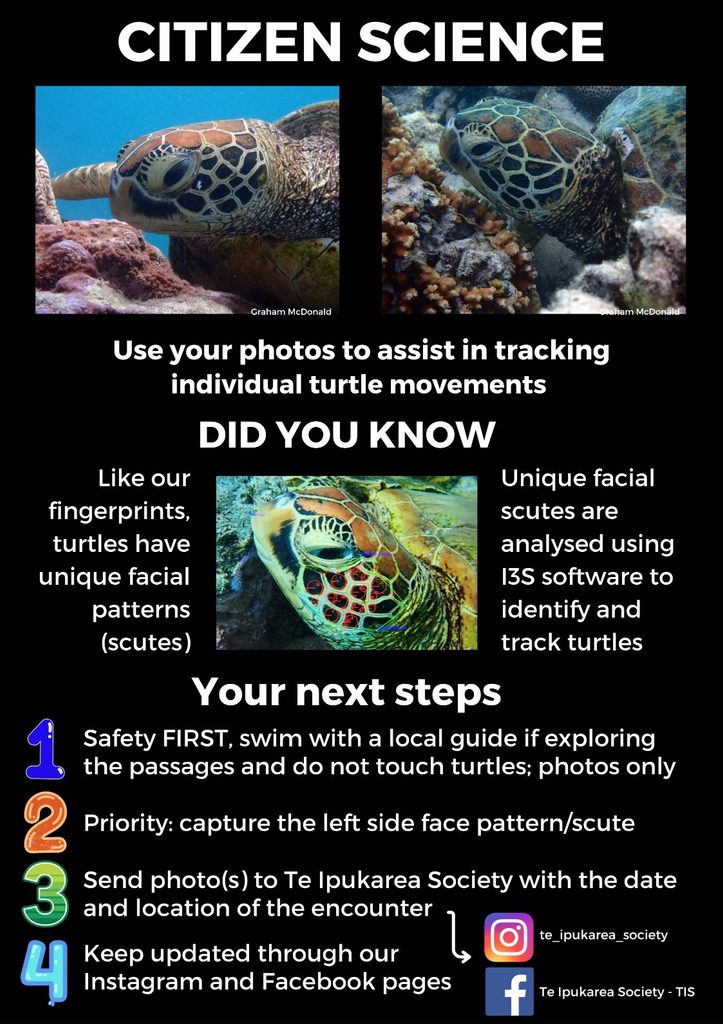
Citizen Science – Turtle tracking
Membership / Representation

BirdLife International
Te Ipukarea Society is a member of BirdLife International
BirdLife International carry out conservation rooted in regional knowledge, working alongside indigenous peoples and local communities to create sustainable change.
Comprising over 123 worldwide organisations, this global network serves as the leading authority on birds.
BirdLife International work in Partnership to unite and strengthen conservation across borders. They organise their work around four key pillars: Species, Sites, Society and Systems.
Click here to find out more about BirdLife International
Deep Sea Conservation Coalition
Te Ipukarea Society is a member of Deep Sea Conservation Coalition.
The Deep Sea Conservation Coalition (DSCC) was founded in 2004 in response to international concerns over the harmful impacts of deep-sea bottom trawling.
Today more than 130 non-governmental organisations (NGOs), fishers’ associations, and law and policy institutes worldwide are working together under the umbrella of the DSCC to ensure the protection of vulnerable deep-sea ecosystems.
The goal of the DSCC is to protect and safeguard deep sea species, biodiversity, and ecosystems and their contributions to planetary health, climate and human wellbeing.
Click here to find out more about Deep Sea Conservation Coalition.

International Union for Conservation of Nature
Te Ipukarea Society is a member of the IUCN
The IUCN (International Union for Conservation of Nature) is the world’s largest global environmental network, uniting governments, NGOs, scientists, and businesses to conserve nature and promote sustainable development.
It serves as a key authority on the status of the natural world, guiding policy and action to address climate change, biodiversity loss, and sustainable resource use.
Click here to learn more about the IUCN

IPEN
Te Ipukarea Society is a member of IPEN.
IPEN (International Pollutants Elimination Network) is a global network of public interest organisations improving chemical policies and raising public awareness to ensure that hazardous substances are no longer produced, used, or disposed of in ways that harm human health and the environment.
Click here to find out more about the IPEN

International Seabed Authority (ISA)
Te Ipukarea Society is an Oberserver organisation at the ISA.
The International Seabed Authority (ISA) is an autonomous international organisation established under the 1982 United Nations Convention on the Law of the Sea (UNCLOS) and the 1994 Agreement relating to the Implementation of Part XI of the United Nations Convention on the Law of the Sea (1994 Agreement).
ISA is the organisation through which States Parties to UNCLOS organise and control all mineral-resources-related activities in the Area for the benefit of humankind as a whole. In so doing, ISA has the mandate to ensure the effective protection of the marine environment from harmful effects that may arise from deep-seabed-related activities.
The Area and its resources are the common heritage of humankind. The Area covers around 54 per cent of the total area of the world’s oceans.
Click here to find out more about the ISA

UN Environment Programme
Te Ipukarea Society is a member of the United Nations Environment Programme (UNEP).
The UNEP is the United Nations’ leading global authority on the environment, driving transformational change on the triple planetary crisis: the crisis of climate change, the crisis of nature, land and biodiversity loss, and the crisis of pollution and waste.
Click here to find out more about the ISA