
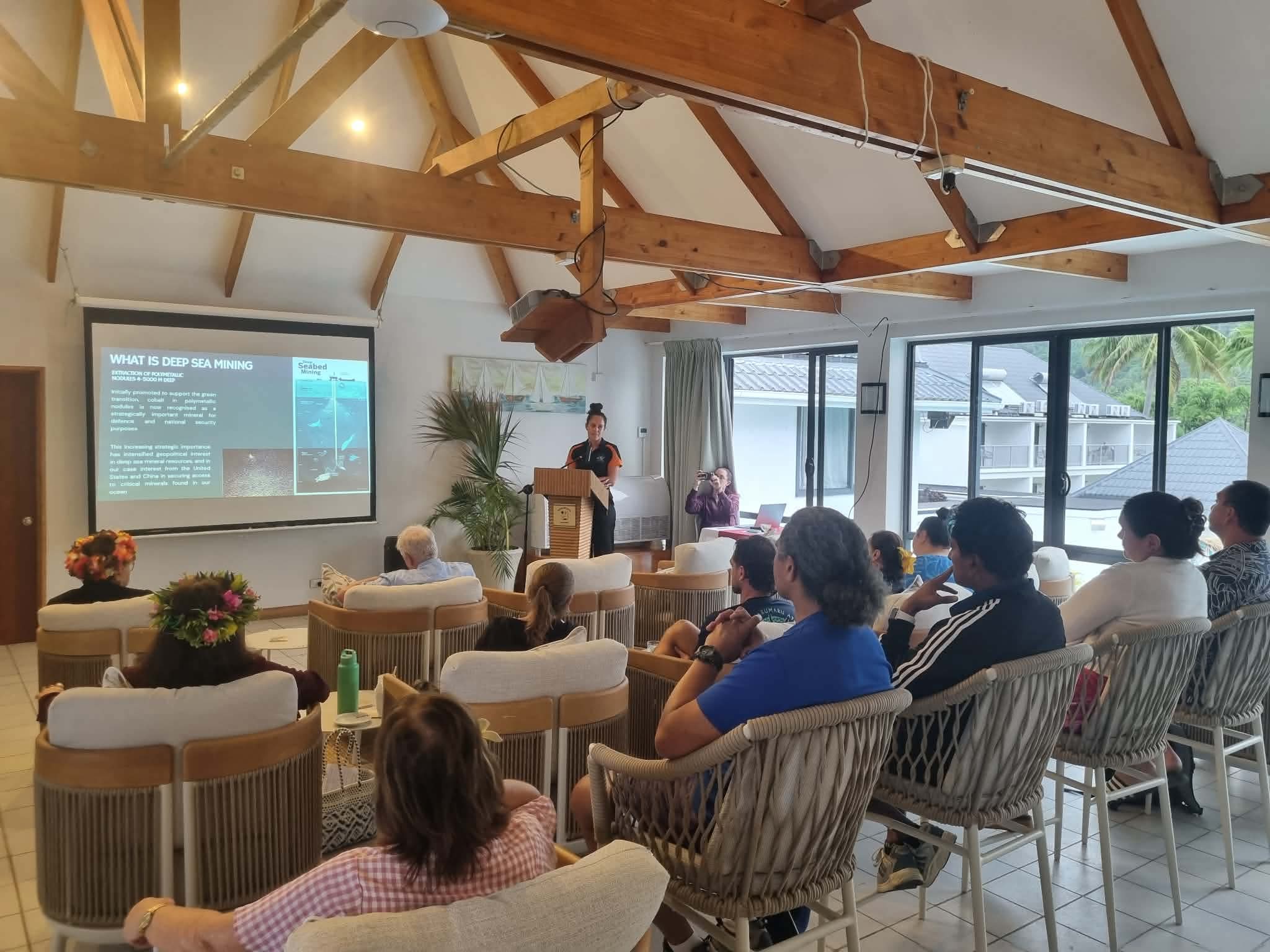
Photo: For the first time, TIS present side by side with SBMA to the Cook Islands Tourism Industry Council
A presentation to the Cook Islands Tourism Industry Council (CITIC) on 21 July at the Muri Beach Club Hotel has highlighted the need for greater clarity, caution and genuine national dialogue around the future of deep seabed mining in the Cook Islands.
In a first-of-its-kind engagement with the tourism sector, Te Ipukarea Society (TIS) and the Seabed Minerals Authority (SBMA) were invited to present to CITIC (Cook Islands Tourism Industry Council) members on the potential deep-seabed minerals industry and what it could mean for the Cook Islands, particularly in relation to the country’s environment, economy, tourism sector and sovereignty.
The session was not framed as a “pro-mining versus anti-mining” debate. Rather, it provided an important opportunity for the tourism industry to hear different perspectives and ask questions on an issue that carries significant environmental, economic, legal and geopolitical implications.
Te Ipukarea Society director, Alanna Smith, opened the discussion by outlining the geopolitical nature of deep-seabed mining and the increasing global demand for critical minerals. She highlighted how the motivations for pursuing these minerals have evolved. While the industry was initially promoted as being necessary for the global green energy transition, demand is now increasingly linked to military, defence and strategic supply chains, particularly for major powers such as the United States and China. “As a sovereign nation, we need to ask whether this is an industry, and a purpose, that Cook Islanders want to be part of.” This is especially true given our Prime Minister’s recent support for the 2025 Pacific Island Leaders Forum Ocean of Peace declaration.
A central concern raised was the need for exploration licence holders to be held accountable for undertaking proper due diligence. TIS stressed that research and assessments must consider cumulative environmental impacts that could contribute to warmer more acidic waters over time, jeopardising our ocean’s ability to function as a carbon sink, which helps keep our planet cool. She emphasised that the deep ocean remains one of the least understood ecosystems on Earth, and that decisions should not be rushed while there are still significant gaps in scientific knowledge.
The economic case for deep seabed mining was also a major focus of discussion. TIS noted that studies undertaken by economists have raised serious questions about whether deep-seabed mining presents a strong or reliable business case for small island states.
Questions from CITIC members focused heavily on the economics of the industry. The discussion made clear that, at present, there is still no confirmed business case for deep-seabed mining in the Cook Islands, and important pre-feasibility studies have not yet been completed.
SBMA outlined its core mandate as the national regulator for seabed minerals activities and focused on the regulatory aspects of the industry.
SBMA also discussed the potential for a niche tourism opportunity through science-led research tourism, where visitors, researchers and students could be drawn to the Cook Islands to learn more about seabed biodiversity and the scientific research being undertaken in the deep ocean.
SBMA indicated that a future deep seabed mining industry could potentially generate between $60 million to $100 million in revenue for the country. This comparison was a key point of reflection during the discussion. Tourism remains the backbone of the Cook Islands economy, contributing more than $500 million annually. While the tourism sector carries its own risks, these are largely known and can be better managed through existing policy, planning and industry practice. Deep seabed mining, in contrast, remains an industry with many unknowns, significant uncertainties and potentially high risks. Without a clear business case, completed pre-feasibility studies and a much stronger understanding of the environmental, economic and legal implications, serious questions remain about whether the Cook Islands should move toward an exploitation phase.
CITIC members also raised questions about the protection mechanisms available to the Cook Islands if the country were to say no to a mining company. Concerns were raised about whether the Cook Islands could be exposed to litigation from exploration companies that have invested heavily in the sector.
Tourism industry members also raised concerns about how much the deep seabed minerals industry is costing the country and taxpayers when no commercial revenue is currently being generated and key pre-feasibility studies have yet to be completed. While the Cook Islands receives $200,000 for a five-year exploration licence, industry participants questioned whether this reflects the true cost of supporting and extending exploration activities through national resources.
A recurring theme throughout the discussion was the need for greater transparency and a stronger sovereign Cook Islands voice. One industry participant described the situation as having “a cloud of fog” around what is being said, what is actually happening, and the various agendas at play. This highlighted the importance of clearer communication, more open dialogue, and ensuring that Cook Islanders are fully informed and meaningfully involved in decisions about the future of this potential industry.
The Society also acknowledged that SBMA is working hard to be seen as a neutral regulatory entity, despite public perceptions that it is a pro-mining agency. TIS said it is important that SBMA and civil society organisations are not positioned as working against each other. This makes transparency, collaboration and genuine consultation even more important.
The Cook Islands has significant local expertise, both scientific and traditional, that should be properly included in shaping decisions about any decision involving activities in unknown depths of the seabed. Any pathway forward must be guided by independent advice, open dialogue and the long-term interests of the Cook Islands people, ocean and future generations.