Traveling through our beautiful Cook Islands today, it is easy to see the march of ‘progress.’
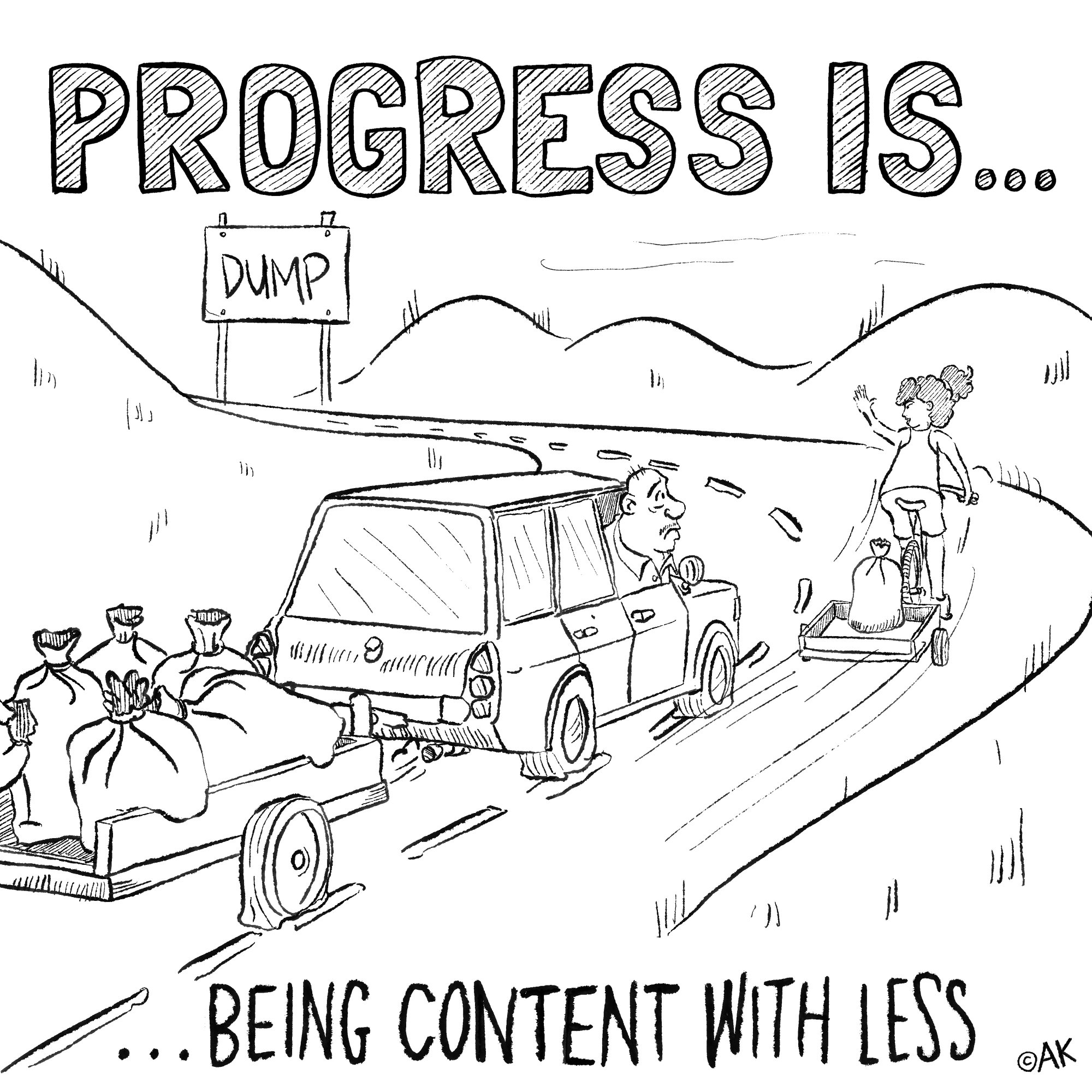
We have faster internet, more cars and gadgets that would have seemed unlikely last century; plenty of nice restaurants, big, well-stocked supermarkets, daily flights and more. But as we look at the rising piles of waste and the growing cost of living, it is worth asking: ‘What exactly are we progressing toward?’
Last century our lives were defined by a different kind of wealth. We were more equipped to be self-supporting; we more readily utilised what was around us, eg coconut fronds for the taro patch, kiriau for costumes, and observing environmental signs for weather prediction or reading the stars for navigation. Today, that self-reliance is fading. We are trading the security of our land for a heavy dependence on the dollar.
The word ‘progress’ suggests we are moving toward something better. But in the modern world, progress often looks like ‘planned obsolescence’—the idea that your phone or fridge is designed to break or become ‘old’ within a few years, so you’ll buy a new one.
On a small island, this isn’t just a financial drain; it’s an environmental crisis. Every ‘upgraded’ device is a future piece of junk that has no place to go.
Our ancestors lived by the philosophy of Akono’anga Māori— the traditional Māori way of taking care of what we have. Modern progress asks us to do the opposite: use, discard, and repeat.
Consider the hidden costs of progress.
- Automation promises efficiency and lower prices. But the cost is often the loss of meaningful employment or reduced options.
- New technology promises better connectivity and health. But the cost is often increased waste: physical rubbish, a drain on time and resources, and a shift toward largely digital connectivity—none of which improves health or social bonding in the long term.
- More money promises access to all the goods you want. But the cost is often deeper debt and a loss of traditional skills and the ability to be self-reliant.
However, progress has another face. While the narrow pursuit of progress offers potential ease of living, true progress is found in human flourishing. This isn’t about what we own, but how we are—how we feel about ourselves, our connection to our ancestral roots, our pito ‘enua, and the strength of our cultural identity.
From this foundation, real progress develops through self-awareness. By understanding ourselves, we are no longer driven to seek external approval or the next digital ‘hype’; instead, we move towards contentment. It is the wisdom to use the best of modern technology to support a healthy lifestyle, without letting ‘progress’ dictate our happiness. It is recognising that people flock here to get a taste of what is already ours.
Research into global happiness often shows a surprising result. People in nations with more traditional, community-focused economies often report being more content and happier than those in wealthy, ‘progressive’ cities. This is because they have mastered the ‘inner’ progress of connection and gratitude. When we replace a local skill with an imported machine, we might save ten minutes, but we lose a piece of our social fabric.
There was a time when people called out to those walking by to stop for kai tī and kōrero—something that might still happen in some of our pa enua—because we had time. Time, the most sought-after commodity in the world. Let us define our own progress in the Cook Islands. Let it be measured not by how much we can buy, but by how much we can preserve. After all, the most ‘advanced’ way to live is to ensure that our children can still feed themselves from a clean ocean and a healthy land, just as we have.
True progress is the courage to live intentionally—taking only the best of the new world to protect the best of the old—so that we, our children and our islands can truly flourish into the future.