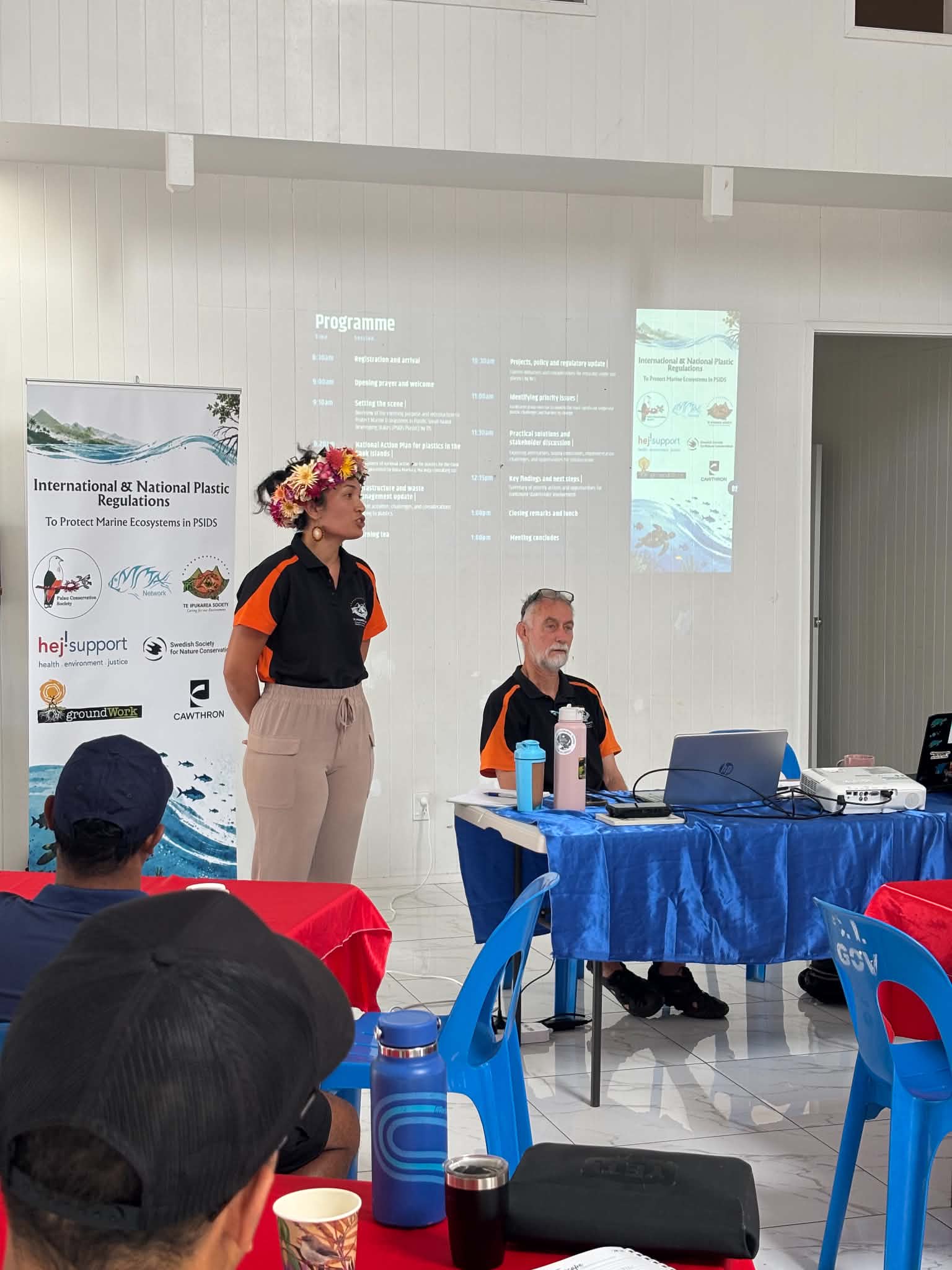
Photo: Sieni Tiraa-Ivaiti and Kelvin Passfield presenting on behalf of TIS
More than 30 representatives from government, the private sector, civil society, tourism, retail, waste management and the Pa Enua gathered at Masters House Hall on 22 September. It was great to see that more than half of the participants were from the private sector.
The meeting focused on trying to identify practical and coordinated solutions to some of the main sources of plastic pollution in the Cook Islands. The multi-stakeholder meeting was organised by Te Ipukarea Society (TIS) through the Protect Marine Ecosystems in Pacific Small Island Developing States project, known as PSIDS Plastic. The meeting was held in partnership with the National Environment Service (NES) and Infrastructure Cook Islands (ICI), both of whom have significant roles in waste management in the Cook Islands.
The meeting brought stakeholders together to discuss current plastics initiatives, implementation of legislation, development of the National Action Plan for Plastics, waste-management constraints, and opportunities to reduce single-use plastics. Participants also explored the affordability and availability of alternatives and the need for stronger cooperation across sectors.
Presentations highlighted the disproportionate burden plastic pollution places on Pacific Small Island Developing States. Although the Cook Islands does not produce plastics, it imports plastic products and packaging and must manage the resulting waste within an isolated island system with limited land, infrastructure and financial resources. Marine litter arriving from beyond the country’s shores adds further pressure, while the health of the ocean remains essential to food security, livelihoods, culture and the economy.
An update presented on the National Action Plan noted that an estimated 15 to 20 per cent of landfill waste, by weight, is plastic, while single-use plastics account for approximately 11 per cent of municipal waste. The plan is intended to shift the national response from end-of-life waste management towards a lifecycle approach covering the importation, use and disposal of plastics. It will support the Cook Islands’ aspiration of Zero Waste by 2045 by addressing plastic pollution at its source. This includes reducing unnecessary plastic imports, strengthening waste-management systems, encouraging behaviour change, suggesting alternatives, improving data, and aligning national efforts with regional and international commitments.
NES outlined the policy and legislative framework supporting plastics reduction, including the Solid and Hazardous Waste Act 2025 and the Environment Act 2026. NES also highlighted education and awareness work in Rarotonga and the Pa Enua, waste audits, beach clean-ups, plastic-free markets, youth initiatives and the promotion of reusable and traditional alternatives. The Cook Islands continues to advocate internationally for an ambitious, legally binding global plastics treaty that recognises the limited infrastructure, high transport costs and transboundary marine litter challenges faced by Small Island Developing States.
ICI emphasised that every imported product has an end-of-life cost, including products promoted as environmentally friendly. Whether materials can be recovered depends on correct separation, storage, equipment, shipping and access to overseas recycling markets. Limited landfill space, contamination, staffing and machinery constraints, and the logistics of servicing the Pa Enua reinforce the need to consider the full lifecycle of proposed alternatives.
During breakout discussions, participants identified packaging, polystyrene, bubble wrap and toiletry containers as significant concerns. Other issues included gaps in plastic import data, affordability of alternatives, insufficient waste-management resources, direct imports into the Pa Enua, enforcement challenges and limited options for recycling or exporting problematic plastics.
Proposed solutions included refill stations for bulk food items such as rice, sugar and flour, reusable takeaway containers, packaging take-back arrangements with overseas suppliers, clearer collection and export systems, increased local production and stronger education and behaviour-change programmes. Participants also supported greater Island Council involvement and further consideration of Extended Producer Responsibility arrangements that would share end-of-life costs among importers, producers, government and waste operators.
TIS Environmental Campaign Manager Sieni Tiraa thanked participants and acknowledged the collaborative approach taken by the National Environment Service and Infrastructure Cook Islands.
“Plastic pollution cannot be addressed by one organisation alone. We need our Pa Enua communities, government agencies, businesses, and civil society working together, with the understanding and support of everyone across our islands. This is a nationwide issue, and we all have a role in the solution.”
The meeting outcomes will contribute to continued stakeholder engagement and the National Action Plan process, including further consultation with the Pa Enua, ministries, non-government organisations, communities and young people. The next multistakeholder meeting for plastic pollution will take place in Aitutaki and Mangaia before the year ends.
The PSIDS Plastic project is supported by the German Government Organisation ZUG, through HEJ support NGO. TIS gratefully acknowledges this donor support and its contribution to protecting marine ecosystems and reducing plastic pollution in the Cook Islands.