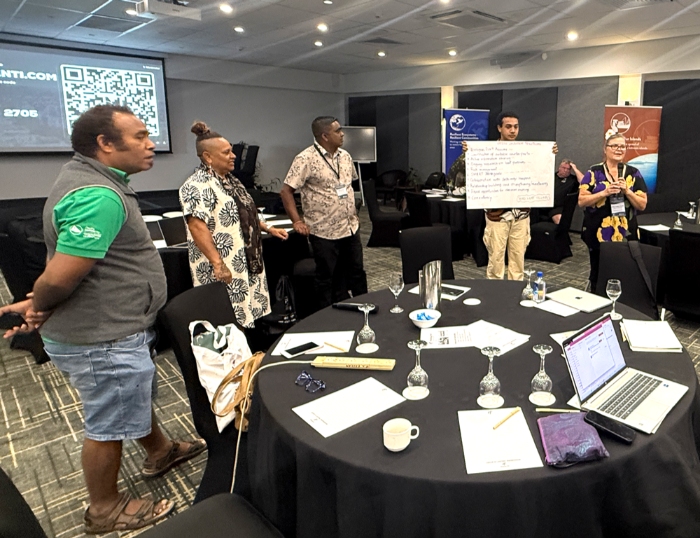
Edna, from Te Ipukarea Society, presents the groups brainstorming on GEDSI inclusion at the Empowering Pacific Narratives Symposium in Fiji. Photo by Kimi Nui, Société d’Ornithologie de Polynésie.
While the vast stretches of the Pacific Ocean physically separate our island countries, a recent regional gathering in Fiji has highlighted just how much common ground exists between us. Along with NGOs were specialists from media, women’s, gender diverse, and disability groups, traditional knowledge holders, and others working in the environment sector from across the ‘Blue Continent’. All Pacific people, meeting to work through how to tell our environment stories in a person-centred inclusive way that engages the average community member.
The symposium, which focused on including GEDSI (Gender Equality, Disability, and Social Inclusion) and TK (Traditional Knowledge), revealed a region that is “One Pacific” when it comes to the ‘big’ issues. We are all fighting the same battle against invasive species and the long-lasting effects of colonisation. However, when we began to discuss Traditional Knowledge (TK), some differences in attitude were noted.
In the Cook Islands, especially in Rarotonga, we have embraced a modern, some might say, colonial way of life. This has its advantages; for instance, our women aren’t held back as much by traditional gender roles. Instead, they are encouraged to become scientists, sailors, even “rat killers”; young women have options.
But our focus on a money economy has come at a cost. While other island groups, such as Fiji, still appear to hold values that TK is a living ‘state of being’—a seamless blend of spirituality and practical science—the Cook Islands has arguably lost touch with some of the wisdom of its ancestors. The workshop reminded us that traditional knowledge is not a relic, but a valuable tool/science that must be rediscovered, protected and respectfully integrated into modern projects. The resurgence of traditional voyaging throughout the Pacific is a great example of this.
The spirit of the week was nicely captured during the inaugural PRISMSS* Restoring Island Resilience Awards. Among six nominated organisations, Te Ipukarea Society was recognised for its collaborative invasive species work, receiving a grant to support its ongoing efforts. The overall winner, the Vava’u Environmental Protection Association (VEPA), provided a moving example of how social equity and environmental work can go hand-in-hand. In training and employing young women, who would potentially be marginalised in their society, to become ‘Environment Ambassadors,’ VEPA keeps youth on the island and shows that healing the land can also mean healing in the community.
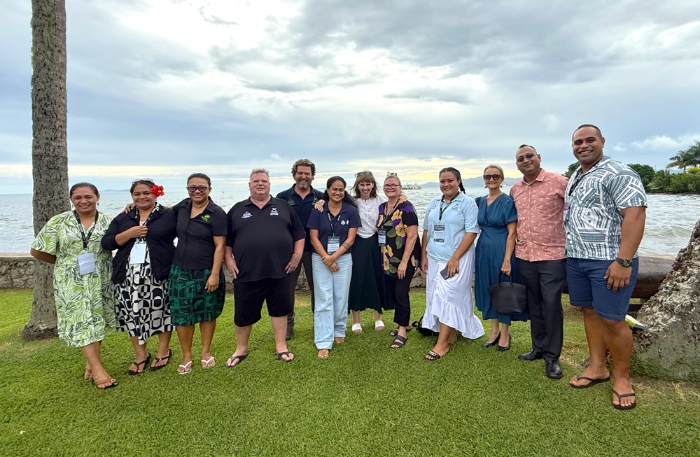
Representatives from the nominated NGOs gather ahead of the awards for a small group discussion with representatives from SPREP and Air NZ who sponsored the inaugural PRISMSS Restoring Island Resilience awards. Photo by Kimi Nui, Société d’Ornithologie de Polynésie
The final days of the symposium saw participants put theory into practice, discussing real experiences, writing them, stripping out technical jargon and consciously including GEDSI and TK to make stories more relatable to the public. The focus shifted from ‘biodiversity data’ and meeting funder requirements, to real-life impacts: eg the fish that sustain our families depend on a healthy reef, which is fed by the nutrient-rich guano (poo) of our seabirds—a cycle that only thrives when we take the first vital step of removing invasive rats.
It also became clear that including everyone—regardless of age, gender, or ability—can be a natural process, provided it is a conscious consideration early on. Whether it is a whole village teaming up to tackle an invasive or training a youth group to manage food security, conservation is most effective when the entire community sees themselves in the story.
*PRISMSS stands for Pacific Region Invasive Species Management Systems Services