
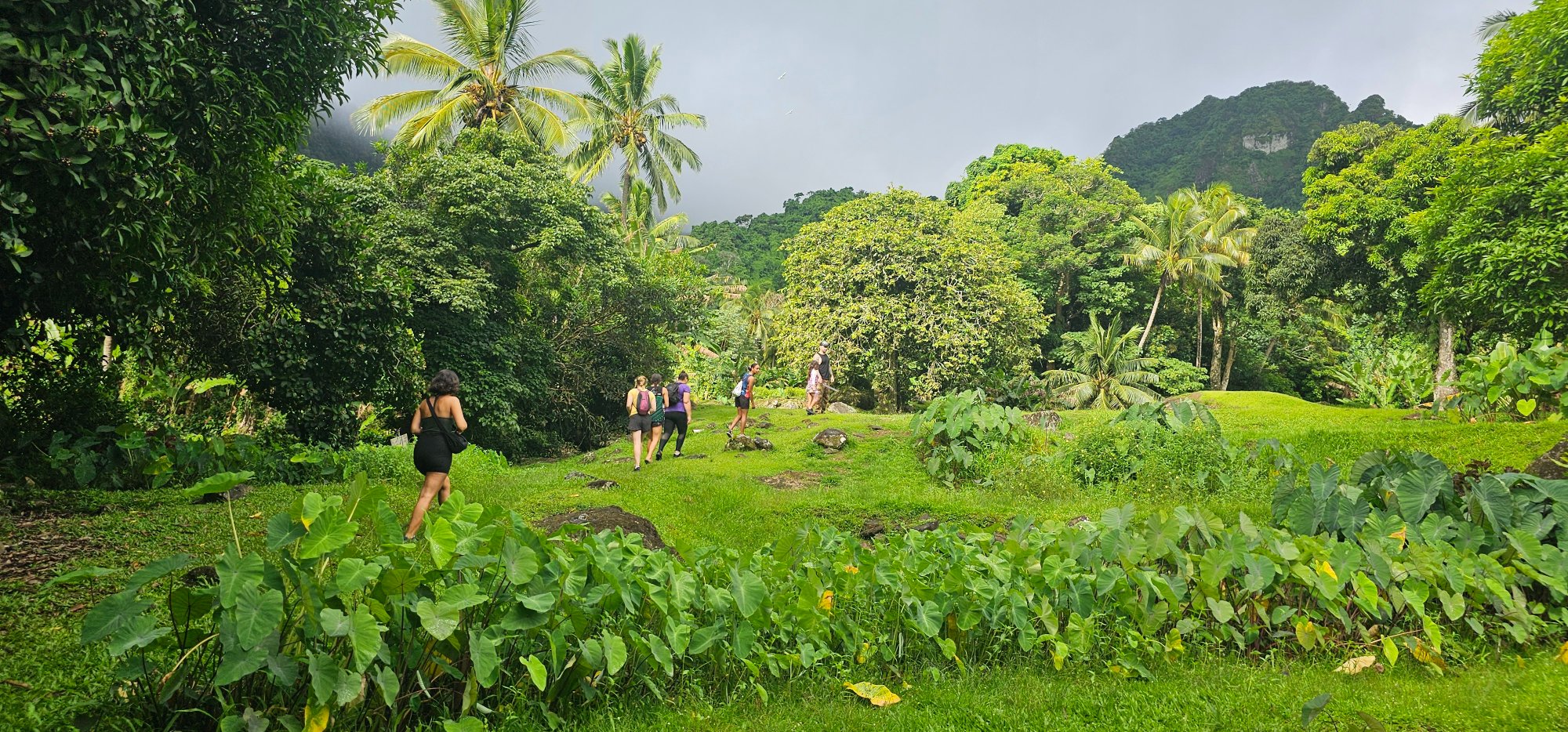
Takuvaʻine Valley is a place rich in biodiversity and a powerful example of cultural knowledge and the environment working together to create sustainable land use. Te Ipukarea Society staff member Akeina Tairea recently joined a group from Te Puna Vai Marama on a visit to the valley, led by researcher Liam Kokaʻua, to better understand its cultural significance and the traditional food systems still present there.
Kokaʻua, a former Te Ipukarea Society (TIS) project officer (2015–2019), is now in his second year as a Pacific Studies PhD candidate at the University of Auckland. His research focuses on documenting the oral histories of Takuvaʻine Valley and exploring the opportunities and challenges of revitalising its taro terraces (pond fields) within the valley’s water catchment.
Takuvaʻine holds deep historical significance in Rarotonga as a key site of traditional Polynesian agriculture. Terraced systems were carefully constructed along the natural contours of the land to manage water flow, supporting the cultivation of food and medicinal plants in harmony with the surrounding environment.
Today, around ten people are actively planting in the valley, continuing practices that date back hundreds of years. However, there is growing concern over the loss of traditional taro variety, particularly rare varieties that may still exist in overgrown, abandoned terraces. In some areas, taro is being replaced by toatoa (watercress), reflecting changing land use.
Some taro varieties in Takuvaʻine are unique, with certain varieties not requiring peeling and known for their naturally sweet skin.
Beyond agriculture, the valley is also rich in cultural and spiritual meaning. One of the main tracks leads to Te Koʻu, a mountain associated with ancestral pilgrimage. Its punāvai (freshwater source) is said to have been visited by the gods Tongaʻiti, ʻAri and Toʻutika, and is linked to the story of Nūnū and Nānā (who control the flow of water from Te Koʻu into Avana valley). Other paths lead to Tāmati Valley, where taro terraces remain but are now largely overgrown, and to Anakitao Valley, an area of strong ancestral connection. Ancient terraces, marae, and remnants of early settlements can still be found throughout the valley.
The landscape of Takuvaʻine is closely tied to wetlands, areas where the land remains saturated due to springs, groundwater, or flowing water. These conditions are essential for sustaining taro pond fields, making wetlands a vital part of this traditional agricultural system. As research and restoration efforts continue, Takuvaʻine Valley remains a living example of how cultural knowledge and environmental stewardship can work together, offering valuable lessons for the future of sustainable land use in the Cook Islands.