The growing presence of United States-based investors and the United States Government in deep-seabed minerals requires greater transparency and public scrutiny in the Cook Islands.
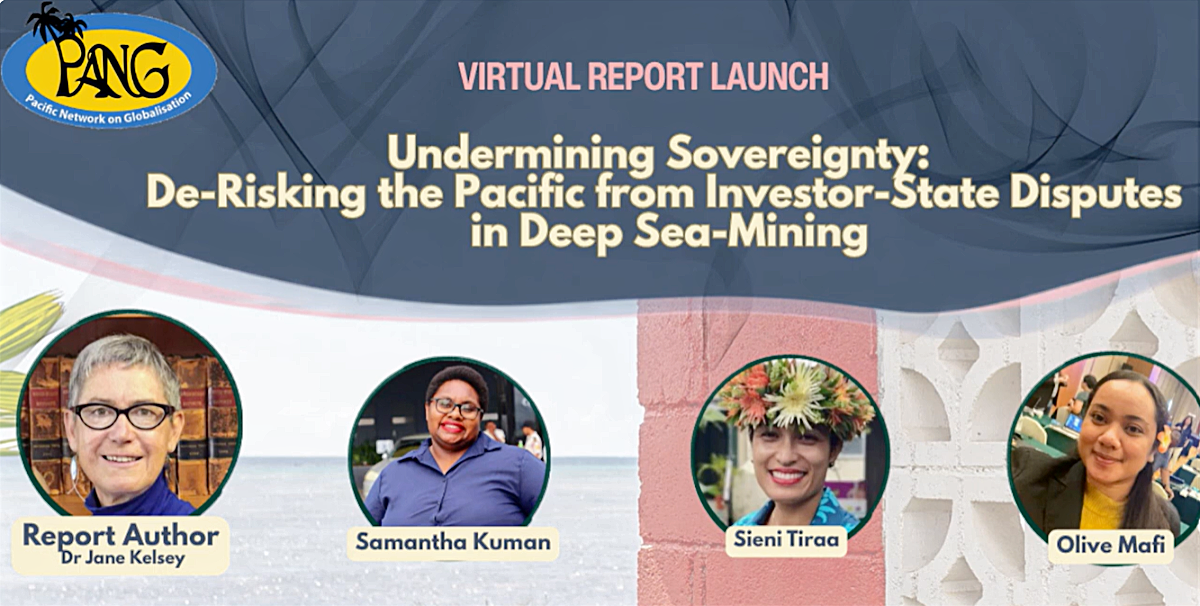
The new Pacific Network on Globalisation (PANG) report, Undermining Sovereignty: De-Risking the Pacific from Investor-State Disputes in Deep-Sea Mining, was authored by Professor Emeritus Dr Jane Kelsey, a specialist in international economic law and policy. It warns that deep-seabed mining could expose Pacific governments to costly and secretive claims through Investor-State Dispute Settlement, or ISDS.
ISDS can allow foreign investors to challenge decisions affecting their investments, including stronger environmental protections, refused approvals, or a change of direction when an activity is no longer in the national interest.
For the Cook Islands, this is becoming more urgent. US-linked companies are connected to exploration licence holders, while related applications are being pursued under US seabed-mining law. Cook Island’s Investment Corporation’s new partnership with New York-headquartered Wetstone, which will hold 49 per cent of Cobalt Seabed Resources Limited, means all three Cook Islands EEZ exploration licence holders are now connected to American investors. The Cook Islands also entered a Critical Minerals Framework Agreement with the United States in February 2026.
“The Cook Islands people need to understand what these changing company structures, foreign-government arrangements and legal commitments could mean for our country,” said Sieni Tiraa-Ivaiti, Environmental Campaign Manager for Te Ipukarea Society.
This is not about opposing relationships with the United States or any other country. It is about ensuring that foreign commercial and strategic interests do not weaken our ability to protect our ocean, regulate responsibly, or act in the interests of our people.
Professor Kelsey’s report identifies five possible pathways to investor claims across the Pacific. Four require particular attention in the Cook Islands:
State-investor contracts: Confidential contracts may contain investor protections and arbitration clauses. Without publication, the public cannot know what rights or liabilities have been accepted.
Sponsorship agreements: Cook Islands sponsorship under the International Seabed Authority may create enforceable obligations alongside international and domestic law.
Domestic legislation: The Cook Islands Seabed Minerals Act 2019 provides for arbitration of certain disputes with sponsored parties and limits the scope of review by domestic courts.
US-issued permits: US-authorised activities may intersect with Cook Islands licences, sponsorship arrangements and the international system under UNCLOS and the International Seabed Authority.
The fifth pathway, bilateral investment treaties, does not currently apply for the Cook Islands, and hopefully never will. However, this report reinforces the need to monitor closely all developments that have an international dimension.
Together, these pathways can produce a chilling effect. The cost or threat of a dispute may pressure a government to delay stronger safeguards, avoid regulatory action, settle privately, or continue with an arrangement it would otherwise reconsider.
Without access to contracts, licences and associated legal instruments, Cook Islanders cannot properly assess what rights have been granted, what obligations Government has accepted, or what financial exposure our country may carry.
Te Ipukarea Society seeks to work constructively with government while promoting transparent, accountable and informed decision-making. We are asking relevant authorities how major changes affecting licence holders are being reviewed and how the public interest will be protected.
“We are grateful for this ISDS report because it helps unpack technical and legal issues that often go over our heads but may have serious consequences for our country,” said Tiraa-Ivaiti.
We need more independent initiatives like this to recognise risks early, keep our finger on the pulse, and protect our sovereign right to act for our people and ocean. You can access a full copy of the report on YouTube or select this link: Undermining Sovereignty: De-Risking the Pacific from Investor-State Disputes in Deep-Sea Mining