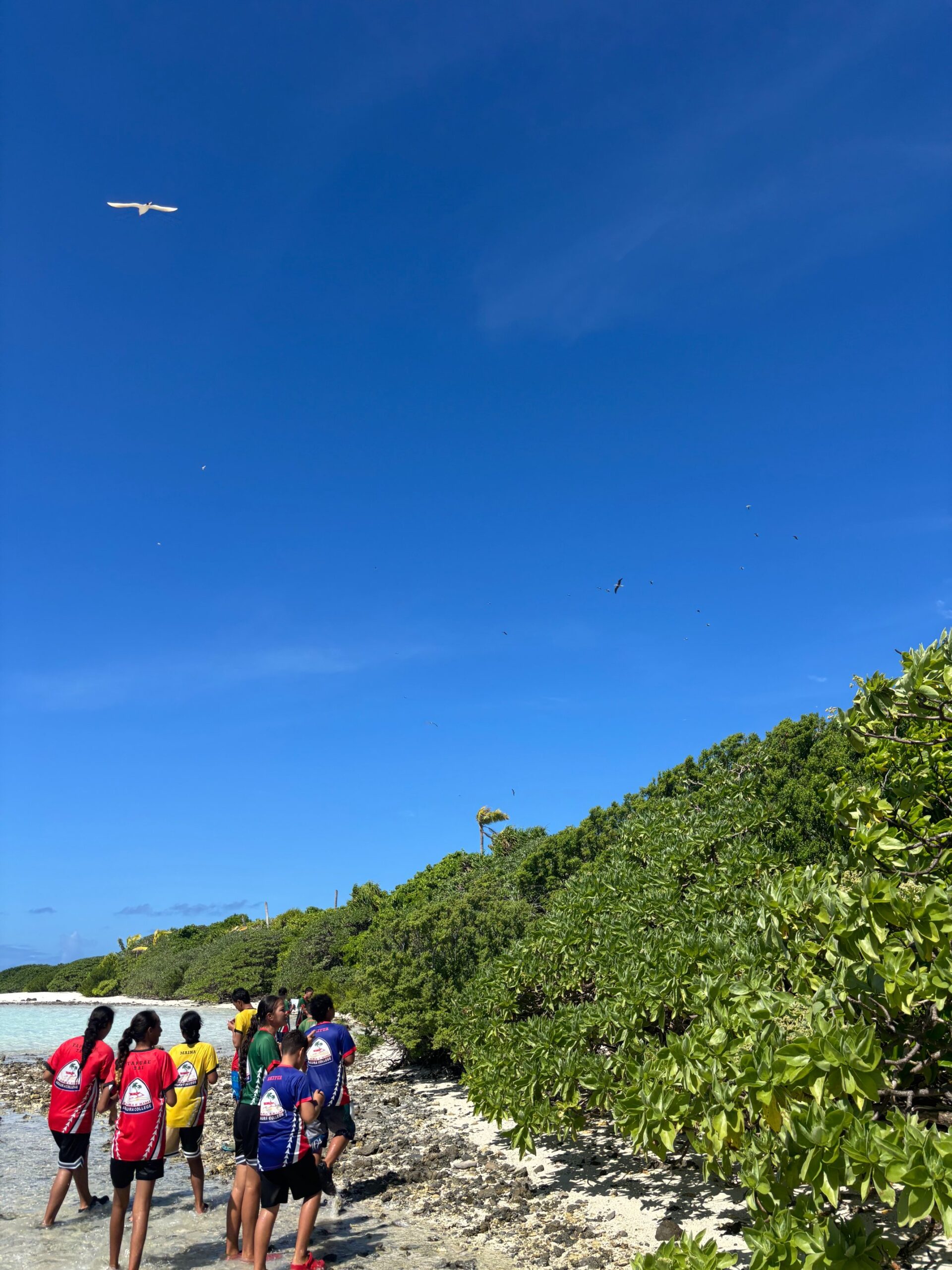
Photo: Araura College students survey nesting seabirds around Motu Kitiu
This week, Te Ipukarea Society was thrilled to take part in GROW Aitutaki’s Te Taunga o te Moana “Learning by Doing” biodiversity awareness programme for Year 7 and 8 students from Araura College in Aitutaki.
The two day programme involved working with the Year 7 students on Monday and the Year 8 students on Tuesday, taking a closer look at the wildlife found within their lagoon and motu ecosystem. Our first stop involved a visit to the shallow sand bank area near Honeymoon Island, where we saw six green turtles (Chelonia mydas) swimming nearby.
We explained to the students how we use facial recognition to identify individual turtles by the unique pattern on the left side of each turtle’s face, much like a human fingerprint. By photographing that side, we are building a database of individual turtles and tracking their movements over time. On this visit, however, the turtles were too wary for us to get close enough for clear identification photos.
Our next stop was the giant clam nursery, home to more than 200 smooth giant clams, Tridacna derasa, originally imported from Palau in the mid-1980s. Since then, they have been successfully bred at the Araura Marine Research Centre hatchery, although they do not appear to be breeding successfully in the wild in Aitutaki. The nursery also holds a number of the largest giant clam species, Tridacna gigas, some nearly 1m across. These were introduced from Australia in 1990 as 1cm babies. As a hands-on learning exercise, the students were given underwater slates and pencils and asked to telly how many derasa vs gigas clams they saw.
From the clams we then moved on to the popular tourist site where people can swim with giant trevally (Caranx ignobilis). These large fish, around 1 metre in length, swam very close to the students in the water and showed no fear at all.
Our final destination was Motu Kitiu, Aitutaki’s main seabird island. The students split into two groups and walked the island’s 1.5km circumference, counting the nesting seabirds they found. The most common were red-footed boobies, toroa (Sula sula), with about 40 nests counted in trees around the perimeter and likely more further inland. Next were tavake, or red-tailed tropicbirds (Phaethon rubricauda), with around 30 nests spotted on the ground, along with a few young chicks. The students also found one lone brown booby, kena (Sula leucogaster) nest on the ground.
From learning about turtle tracking to practising population surveys, comparing gigas and derasa clams, and estimating seabird numbers on Motu Kitiu, the students gained valuable hands-on experience. It has been wonderful to see the young people of Aitutaki deepen their understanding of local biodiversity and the important role they can play in caring for Aitutaki’s environment.
Big meitaki atupaka to GROW Aitutaki for coordinating the Te Taunga o te Moana youth programme and creating more biodiversity learning opportunities for the youth of Aitutaki. We also thank the New Zealand High Commission, Rarotonga, Cook Islands for supporting this work, and the Wet and Wild team for ensuring safe travel across the lagoon to the different survey sites.