Ecologically Sustainable Development
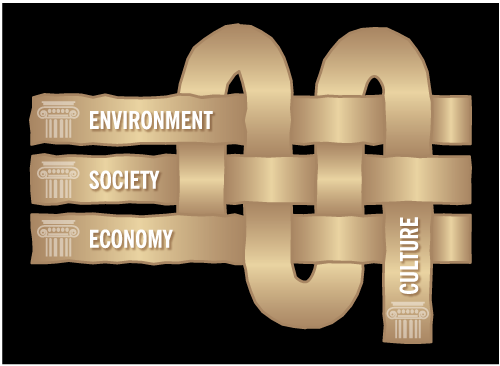
In brief, Eco-Sustainable Development means managing our current needs without compromising the ability of future generations to meet theirs. It is about finding the balance between the needs of the Economy, Environment, Society and Culture now, with a view to future citizens as well.
Te Ipukarea have been active and pro-active in supporting/promoting ideas for Regenerative (green) tourism, offshore fisheries, and in helping to develop and implement Tourism Environmental Guidelines and the Mana Tiaki tick programme.
Our current focus is to:
- raise awareness about deep-seabed mining risks and knowledge gaps, and
- educate on the importance of a healthy ocean to life on earth.
Deep-seabed mining statement

The deep sea is home to a range of diverse and unique species and ecosystems. Some deep-sea areas within the Cook Islands Exclusive Economic Zone (EEZ) are also rich in polymetallic nodules, which contain valuable minerals. The nodules grow over millions of years in very stable environments, and are the target of commercial mining interest, both within our EEZ, and outside, in Areas Beyond National Jurisdiction (the international seabed).
Our Society is concerned that with the current level of scientific uncertainty around the deep sea and deepsea mining means that measures to mitigate or avoid environmental impacts will not be effective. Therefore our position is, that a minimum 10-year moratorium is the most appropriate application of the Precautionary Principle. This is consistent with the statement of over 660 marine scientists and policy experts who have signed a statement calling for a pause on deep sea mining.
We are a full member of the IUCN (International Union for the Conservation of Nature) and our position aligns with the IUCN Resolution 122 which calls on all State Members of IUCN to support and implement the Protection of deep-ocean ecosystems and biodiversity through a moratorium on seabed mining. Refer full text of Resolution 122 here WCC_2020_RES_122_EN.pdf
Our position would also:
- align with the UN Decade of Ocean Science for Sustainable Development 2021-2030;
- allow for more international scientific research to be carried out, particularly by non mining institutions, resulting in reduced uncertainty;
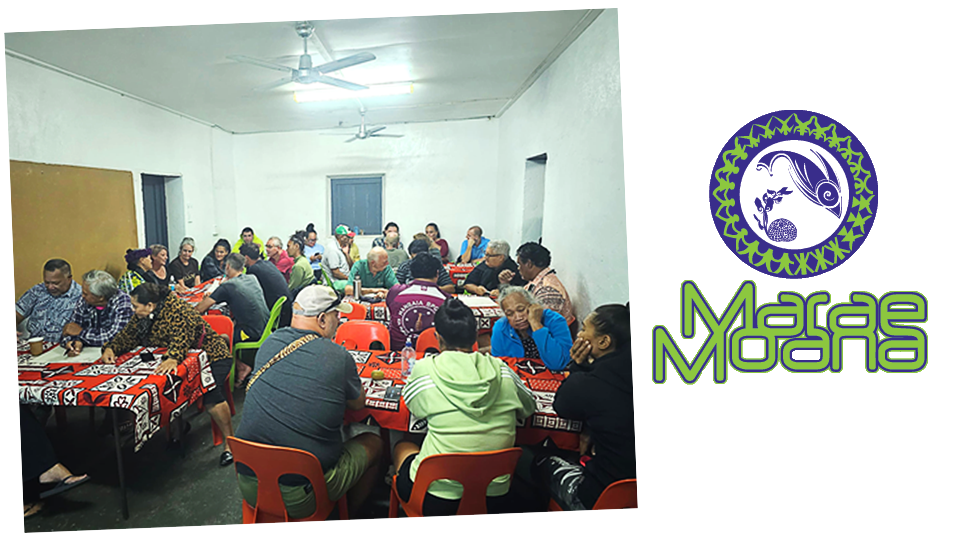
- allow time to complete the Marae Moana Marine Spatial Plan;
- allow time to further investigate the potential for a resource-efficient circular economy without the need to mine for new metals;
- not interfere with the Cook Islands efforts to contribute to global biodiversity targets;
- allow time for the Cook Islands Seabed Minerals Authority (SBMA) and the International Seabed Authority to improve efforts to transparently and effectively engage
stakeholders in decision-making processes; and - allow time for the SBMA to invite independent research organisations to assist the Cook Islands with deep sea research, in order to avoid conflicts of interest that would inevitably arise if this research is carried out solely by mining companies.
While the Society are predominantly concerned with impacts of mining for polymetallic nodules in the Cook Islands context, we appreciate that Cook Islanders are also beneficiaries of the common
heritage of mankind, and that the Cook Islands is a sponsor state to an exploratory contract in the Clarion-Clipperton Zone in the high seas. As such, we are concerned about all types of deep-sea mining, and the lack of scientific information around the entire deep-sea and the global industry.
Click here to view our full Position Statement on Deep Sea Mining (November 2020)
Click here to view our submissions to the SBMA on the three applications for Exploration Licenses (December 2021)
Click here to view our submission to the Cook Islands Seabed Minerals Act 2019
Click here to view our submission to the Cook Islands Seabed Minerals Amendment Act 2020
The common heritage of humankind
The Cook Islands has an obligation to contribute to the protection of the common heritage of humankind
The deep seabed in international waters beyond the Cook Islands, is also referred to as the Common Heritage of Humankind. As a sponsoring State of an area proposed for mining in the Clarion Clipperton Zone, the Cook Islands has a responsibility to protect it, just as we do our own seabed.
Deep seabed mining (DSM) is at a crossroads of advanced technological capabilities and improved scientific understanding of the oceans.
We have the mechanisms to mine the deep, but we also know that, much like land-based mining, DSM is expected to cause significant environmental harm to not just the seabed but potentially the water column above it. (Drazen et al., 2020)
There is increasing market demand for development of the seabed and its minerals. This corresponds with an increasing number of scientists who are “expressing concern about the potential for long-term and significant harm arising from deep-seabed mining”. (Jaeckel, Gjerde and Ardron, 2017; Chin and Hari, 2020)
The United Nations Decade of Ocean Science (2021-2030) and the call for a 10-year moratorium on DSM are an international recognition of the ocean’s importance to our future wellbeing and the need to check our unprecedented exploitation of marine resources.
It can be a time to enhance our understanding of the oceans and fully integrate the UN Sustainable Development Goals that call for a circular economy and precaution-based uses of our global common resources.
The Common Heritage of Humankind
Alfrid Pardo was the ambassador of Malta to the United Nations Convention on the Law of the Sea (LOS) in the 1960s. Pardo, and other small island nation representatives, fought to designate the poorly understood deep seabed, beyond national boundaries, as the Common Heritage of Humankind.
As a result, the Earth’s largest ecosystem has been legally designated as a common resource. Under international law, this demands a continuing return to humankind over the generations. (Wolfrum, 2009; Lodge, 2012; Jaeckel, Gjerde and Ardron, 2017) Indeed, the Common Heritage of Mankind “informs every aspect of the seabed mining regime.” (Jaeckel, 2017, p. 81)
The Cook Islands is a sponsoring State alongside a mining company with a claim to mine in the international waters (specifically the Clarion Clipperton Zone). As sponsors, we have a role as global citizens to provide an important safeguard for environmental protection of our common heritage.
The principle of state sponsorship as an important component of protecting marine environments was upheld by the Seabed Disputes Chamber and the requirement for a precautionary approach in DSM activity was simultaneously reinforced (Freestone, 2011; see also the 2011 ITLOS Decision on Sponsoring States) The decision emphasized that sponsoring states have a “direct obligation” to assist the ISA in exercising its authority over the Common Heritage of Mankind. (Freestone, 2016)
The scientific understanding of the deep seabed and the water column above, although still minimal, has improved and we now know it to be a home of thriving ecosystems and unique species found nowhere else on earth (Miller et al., 2018). As a “custodian of the common heritage of mankind,” (International Seabed Authority, 2018, para. 8) the ISA and the Cook Islands are responsible for ensuring that its development is done in a manner consistent with the international demand for sustainability and protection of biodiversity. (Hunter, Singh and Aguon, 2018)
The eyes of the world are upon us. As a sponsoring State, the Cook Islands plays a vital role in ensuring that DSM activities, both within its EEZ and without, do not cause significant harm to the marine environment. Without a 10-year moratorium to study and better understand this new frontier can the Cook Islands, or the ISA, adequately fulfill this role?
Note all references in the text are available on request.

A 26-year-old test-mining track in the Peru Basin, Pacific Ocean illustrates how slowly abyssal ecosystems of the deep seabed recover from physical disturbance. Image: Geomar, ROV Kiel 6000. From Chin, A and Hari, K (2020)
The effect on our oceans
Deep seabed mining could cause irreversible harm to our oceans, from the seafloor to the surface and the midwater columns in between
Industrial scale deep seabed mineral mining (DSM) has never successfully occurred anywhere in the world. This is due, in part, because the deep oceans are poorly understood. The immense pressure, at depths of 200 meters and more, makes it difficult to access and expensive to explore and monitor. And despite being the largest ecosystem on the planet, humanity knows more about the surface of the moon than we do about our deep sea ecosystems. (Sharma, 2017; Drazen et al., 2020) However, for over a decade scientist have been warning the international community of the alarming shifts the ocean’s water column is experiencing, and is expected to experience, as a result of climate change. (Davies et al., 2007; Dunn et al., 2018; Johnson et al., 2018) The midwater column is important to the stability of global marine biodiversity and the ocean food webs. (Danovaro et al., 2004) And although many of the direct impacts remain unknown, it is inaccurate and dangerous to claim that DSM will not directly affect the stability of the midwater column through the discharge of sediment plumes and noise.

The predicted impacts of deep seabed mineral mining on the marine environments of the deep ocean midwater columns and the effected ecosystem services. Graphic Credit: (Drazen et al., 2020)
The deep-sea water column (>200m) makes up roughly 93% of habitable ecosystem for the entire planet, land and sea, and plays a vital role in sustaining marine biodiversity. (Danovaro et al., 2008) It has only been in the last decade that we have begun studying the shallowest part of this immense ecosystem: the mesopelagic water column (200-1000m), also known as the twilight zone. Current modelling predicts that the twilight zone’s fish populations are the most abundant of any species on the planet and number 100x more than the current global annual fish catch. (Irigoien et al., 2014) The importance of this water column on global biodiversity cannot be understated. It is therefore vital that we recognize and seek to fully understand the unavoidable impacts DSM will have on this region and the consequences of those impacts on the rest of the ocean systems, specifically the Cook Island fisheries. To ensure effective protection of the marine environments and avoid causing serious and irreversible harm, the Cook Islands must ensure a precautionary approach to any mineral activity, including exploratory mining activities.
The precautionary approach has been established as a valuable tool for environmental protection within international law. Considered the founding codification of the principle, article 15 of the 1992 Rio Declaration on Environment and Development states:
“In order to protect the environment, the precautionary approach shall be widely applied by States according to their capabilities. Where there are threats of serious or irreversible damage, lack of full scientific certainty shall not be used as a reason for postponing cost-effective measures to prevent environmental degradation.“
It is possible that permittable exploratory mining activities, even cautiously applied, cause irreversible harm due to a lack of scientific certainty.(Levin et al., 2016) In fact, it is generally accepted that DSM activities will inevitably cause irreversible loss of marine biodiversity with still unknown domino impacts on the rest of the ocean system.(Niner et al., 2018) It is therefore important that the CI Seabed Minerals Authority fully understand the “threats of serious or irreversible damage” that exist prior to issuing mining licenses and approving applications. To fully comprehend the risks of rushing this process and the importance of supporting the international calls for a 10-year deep-sea mining moratorium, we need look no further than the recent failure of Papua New Guinea’s NZD$160m deep-sea mining venture.
The collapse of PNG’s Solwara-1 mining site is evidence that the technology required to effectively protect the marine environment and ensure a precaution-based approach to mining activities is not available and should be a warning to all Pacific Island nations. It is crucial that we take precaution-based steps to understanding the impacts of DSM, not only on the deep seabed but throughout the midwater column, our shallow water shorelines and our beaches.
References
Danovaro, R., Dell’Anno, A., and Pusceddu, A. (2004). Biodiversity response to climate change in a warm deep sea. Ecol. Lett. 7, 821–828.Danovaro, R. et al. (2008) ‘Exponential Decline of Deep-Sea Ecosystem Functioning Linked to Benthic Biodiversity Loss’, Current Biology, 18(1), pp. 1–8. doi: 10.1016/j.cub.2007.11.056.
Davies, A. J., Roberts, J. M. and Hall-Spencer, J. (2007) ‘Preserving deep-sea natural heritage: Emerging issues in offshore conservation and management’, Biological Conservation, 138(3–4), pp. 299–312. doi: 10.1016/j.biocon.2007.05.011.
Drazen, J. C. et al. (2020) ‘Midwater ecosystems must be considered when evaluating environmental risks of deep-sea mining’, Proceedings of the National Academy of Sciences of the United States of America, 117(30), pp. 17455–17460. doi: 10.1073/pnas.2011914117.
Dunn, D. C. et al. (2018) ‘O C E A N O G R A P H Y A strategy for the conservation of biodiversity on mid-ocean ridges from deep-sea mining’, (July), pp. 1–16. Available at: http://advances.sciencemag.org/.
Irigoien, X. et al. (2014) ‘Large mesopelagic fishes biomass and trophic efficiency in the open ocean’, Nature communications, 5(May 2013), p. 3271. doi: 10.1038/ncomms4271.
Johnson, D., Adelaide Ferreira, M. and Kenchington, E. (2018) ‘Climate change is likely to severely limit the effectiveness of deep-sea ABMTs in the North Atlantic’, Marine Policy. Elsevier Ltd, 87(October 2017), pp. 111–122. doi: 10.1016/j.marpol.2017.09.034.
Levin, L. A. et al. (2016) ‘Defining “serious harm” to the marine environment in the context of deep-seabed mining’, Marine Policy. Elsevier, 74(October), pp. 245–259. doi: 10.1016/j.marpol.2016.09.032.
Niner, H. J. et al. (2018) ‘Deep-Sea Mining With No Net Loss of Biodiversity—An Impossible Aim’, Frontiers in Marine Science, 5(March). doi: 10.3389/fmars.2018.00053.
Sharma, R. (2017) Deep-Sea Mining: Resource Potential, Technical and Environmental Considerations. Edited by R. Sharma. Springer. doi: 10.1007/978-3-319-52557-0.
Deep-seabed mining risks – reels in te reo Māori Kūki ‘Airani

24/7 noise from mining will impact whales

Mid water discharge of toxic fine sediment

Trials as far back as 50 years show no signs of recovery

Turbidity risks from plumes

Toxic seafloor plume with travel and smother.

Noise from mining will disturb all ocean life living in dark, dependent on sound communication

Plumes will smother the phyto- and zooplankton critical to human life

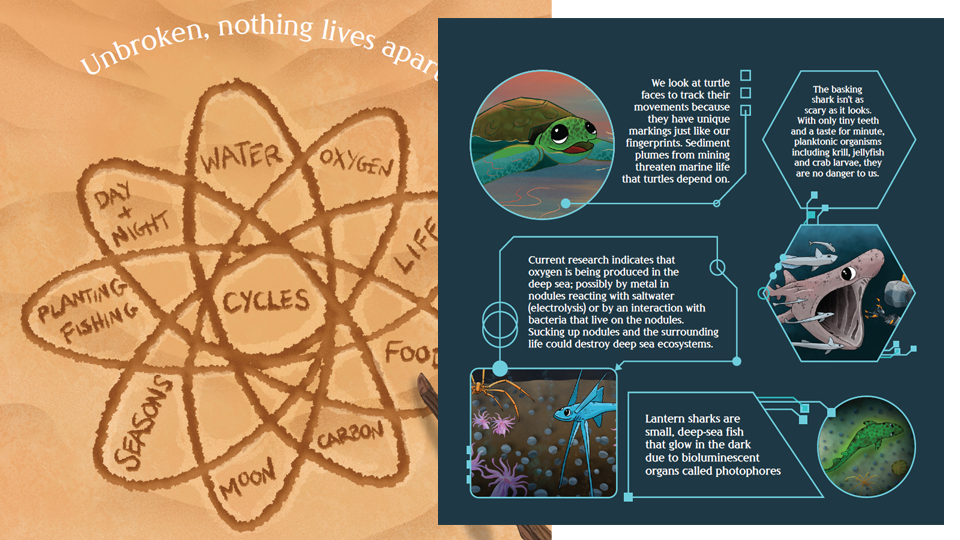
Nodules have a purpose in creations design, eg oxygen and habitat
Image gallery