Image: Adapted from Koelle on de.wikipedia – Koelle, selbst fotografiert, own photo, CC BY-SA 3.0, https://commons.wikimedia.org/w/index.php?curid=1345805
The Moana is not just a large body of sea water, it is our food basket, a part of our identity, and our future. Yet as the people of the Cook Islands prepare to vote in the upcoming elections, a quiet danger is lurking beneath the surface of our waters. Instead of exercising the traditional caution of our ancestors, the current government is actively collaborating with mining companies to push ahead with deep-sea mining (DSM).
Te Ipukarea Society (TIS) has consistently questioned the need for DSM in the Cook Islands, highlighting significant environmental and social risks.
Today, as political pressure to greenlight commercial mining of our deep seabed intensifies, a silent and unacknowledged threat is being closely looked into: the risk of DSM releasing radioactive material into our waters, putting our marine life and our food supply at risk.
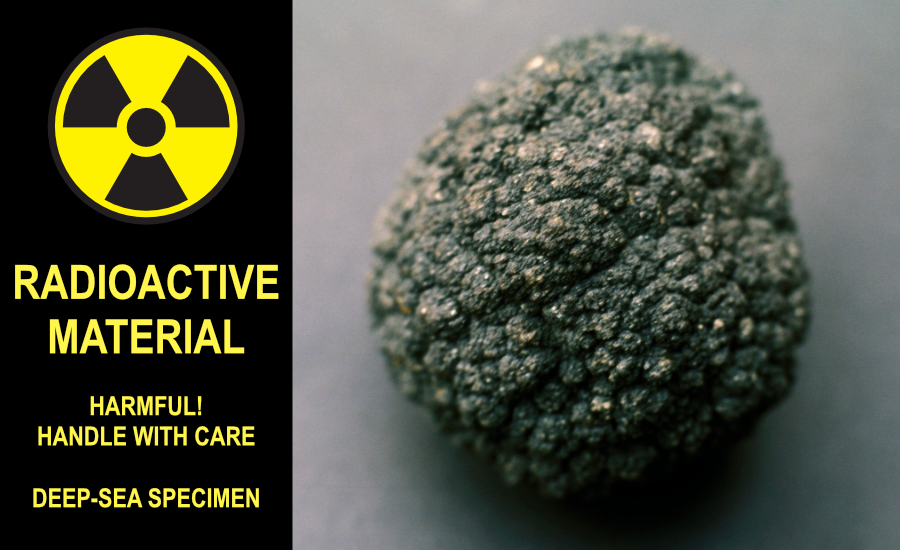
The deep sea of the Cook Islands is a treasure trove of biological diversity, home to unique life forms thriving in some of our world’s harshest conditions. It is also a sink for naturally occurring radioactive particles. Over millions of years, these have accumulated on the very polymetallic nodules that foreign mining companies are eager to scoop up. Most of these particles emit ‘alpha’ radiation.
Alpha radiation is easily blocked by even thin barriers such as skin or paper. But it is extremely dangerous if swallowed or breathed in. Once inside the body it can damage our cells, proteins and our DNA, causing mutations.
Under natural conditions the alpha particles are safely locked away in the rocks and marine life has adapted to natural background levels of radioactivity. Industrial seabed mining will shatter this balance.
By crushing nodules, disturbing the seabed, and pumping mining wastewater back into the ocean, deep-sea mining risks spreading radioactive particles into shallower waters. These contaminants could move through the marine food web and ultimately affect our tuna stocks, which may become contaminated by consuming polluted prey.
Our Government, the companies, and scientists do not know the combined effect of DSM spreading toxic heavy metals and radioactive particles in the ocean. Both can accumulate in the bodies of marine life and magnify up food chains, in much the same way as ciguatera poison–little fish are eaten by bigger fish that eventually end up on the dinner plates of Cook Islands families.
A new report, available from TIS, identifies 10 important research questions that must be answered before we know the likely risks and effects of radioactive isotopes released by deep sea mining on marine life, ecosystems, and food webs. These questions must be answered before DSM is allowed here in the Cook Islands or anywhere.
This upcoming election presents a defining choice for the future of our nation. To take a gamble on an industry that threatens our Moana, or to use our votes to create an impact, tread cautiously, and to make sure that decisions about deep sea mining are based on science not rushed greed. The recently published report, ‘Critical Questions About The Risks Of Radiation Toxicity From Deep Sea Mining” can be found online. The paper is based on a review of published literature, understanding our current knowledge on deep sea mining induced radiation toxicity in marine ecosystems.