
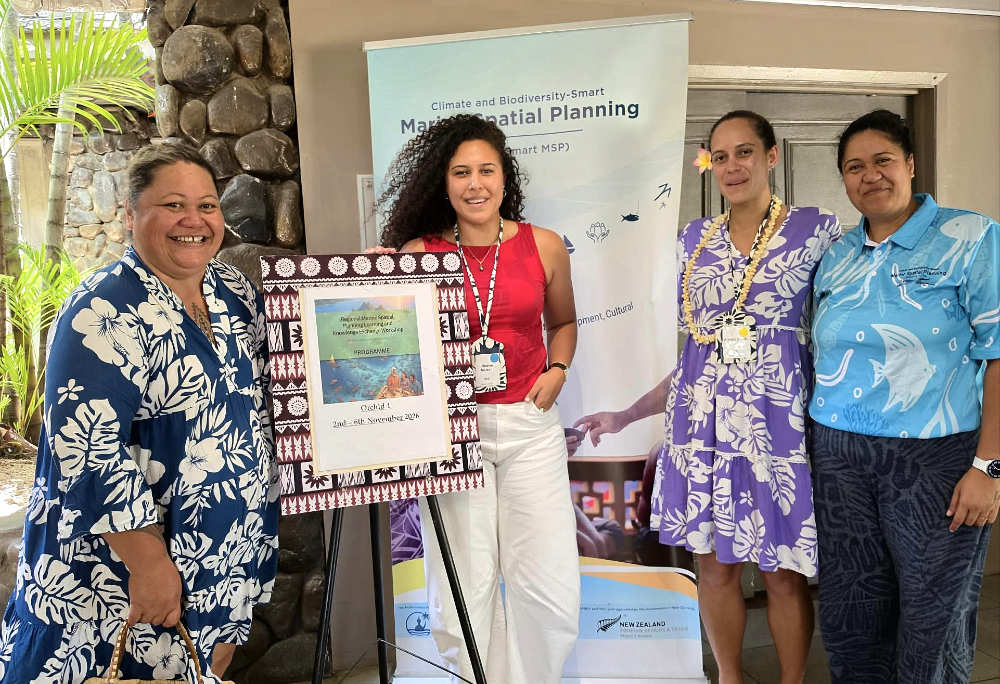
Photo: Alanna in Fiji at the Regional Marine Spatial Planning Learning and Knowledge Exchange Workshop. A time for Pacific states, regional organisations and technical partners to learn, share insights and reflect.
In a world experiencing a growing population and increasing demand for marine resources, how we organise, use and protect our ocean space has become more important than ever. For the Cook Islands, where our ocean is connected to our culture, livelihoods, food security and identity, ensuring its sustainable management is vital for both current and future generations.
While the practice of managing marine resources is not new to Pacific Islanders, who have long used traditional approaches such as rā‘ui to protect important areas and allow resources time to replenish, the modern-day term for this broader approach is Marine Spatial Planning (MSP).
Marine Spatial Planning can be thought of as town planning for the ocean. It involves identifying how different activities can take place within the same marine environment, while ensuring that the health of the ocean and its ecosystems are maintained. This includes considering where fishing, shipping, conservation and other economic activities should occur, and how potential conflicts between these activities can be managed.
For the Cook Islands, marine spatial planning is becoming increasingly important, particularly in the deeper waters beyond our reefs and extending out to the boundaries of our Exclusive Economic Zone (EEZ). These waters are subject to growing interest from a range of industries and users, including community fishing grounds, commercial fisheries, international cargo shipping routes and, more recently, deep-sea mining.
As these interests continue to grow, careful planning is needed to ensure that decisions about our ocean are informed by independent science, traditional knowledge, community priorities and a long-term vision for ocean health. Marine Spatial Planning provides an opportunity to consider not only the economic value of our marine resources, but also their ecological, cultural and social importance.
To strengthen the development and future implementation of Marine Spatial Planning in the Cook Islands, a local delegation from Te Ipukarea Society (TIS), the National Environment Service (NES), Marae Moana and Cab Smart recently attended a regional learning and knowledge exchange workshop. The workshop brought together representatives from other Pacific Island states, regional organisations and technical partners to share experiences, discuss challenges and learn from one another’s approaches to marine planning.
These regional exchanges are particularly valuable for Pacific nations, which share many of the same challenges in managing vast ocean areas, balancing economic development with conservation, and ensuring that communities remain involved in decisions that affect their ocean.
The Cook Islands is currently in the drafting stages of developing a Marine Spatial Plan for its deeper waters. Discussions and technical considerations are being progressed through the Marae Moana Technical Advisory Group (TAG), which brings together representatives from government agencies, non-government organisations and the House of Ariki. This collaborative approach is important in ensuring that a range of perspectives and expertise contribute to the planning process.
Ultimately, Marine Spatial Planning is about more than simply dividing the ocean into different zones. It is about establishing a shared vision for how our ocean should be managed, ensuring that its resources are used responsibly while safeguarding the marine environment that sustains us.
As Cook Islanders, our ocean is our inheritance, and we have a responsibility to ensure it remains healthy and productive for generations to come.
Meitaki ma‘ata to the New Zealand Ministry of Foreign Affairs and Trade (MFAT) for supporting Te Ipukarea Society’s participation in these important regional discussions and knowledge-sharing opportunities.