
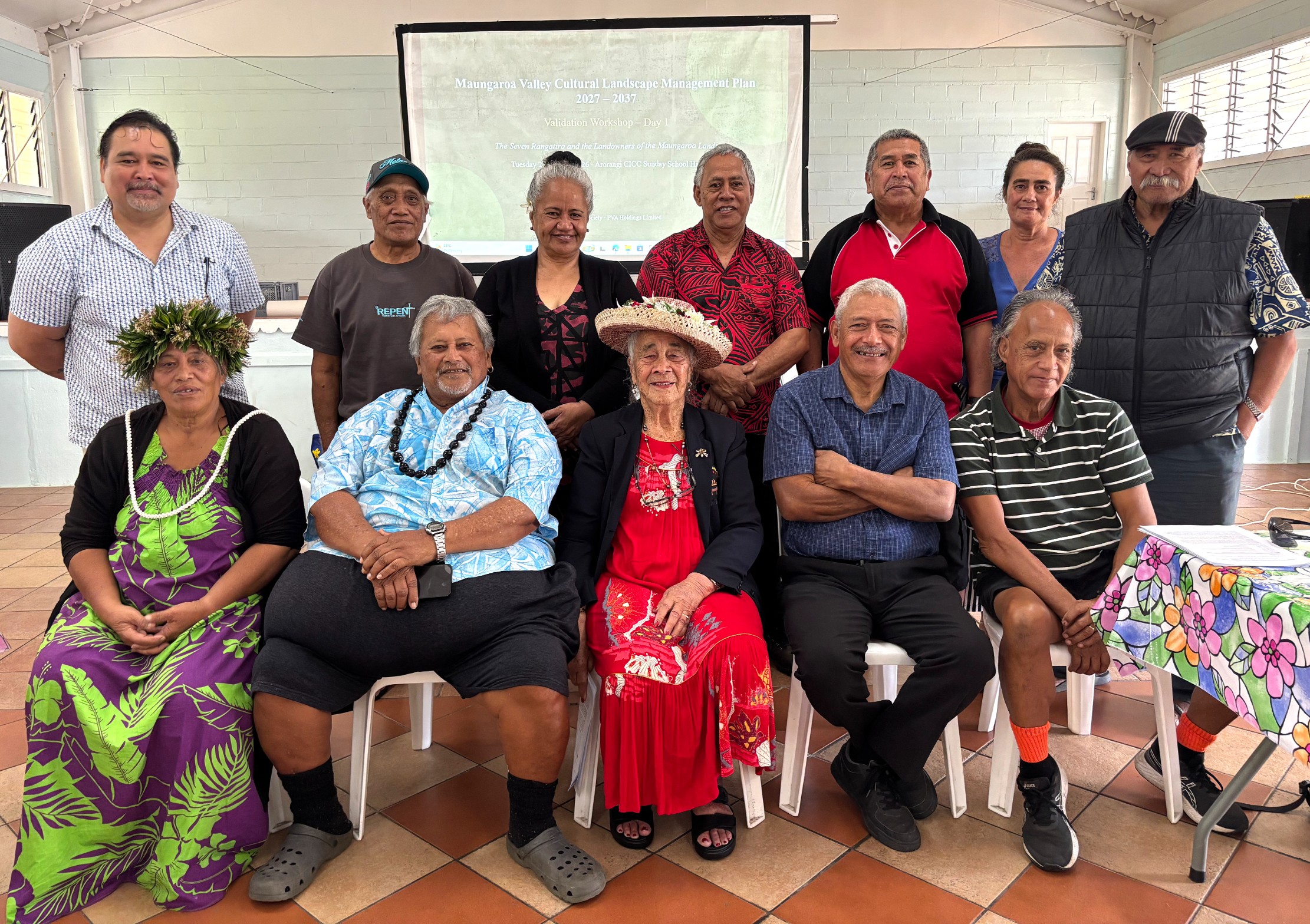
Photo: Traditional leaders of Puaikura with Tinomana Ariki – all participated in the 3-day workshop
Located inland in the village of Arorangi, Maungaroa Valley is a place of rich cultural and historical significance to the people of Puaikura. The valley contains the remains of old settlements believed to be more than 400 years old, preserving important connections to the history, identity and traditions of the Cook Islands.
Often described as a place of history and legacy, “where we come from”, Maungaroa is regarded as sacred and tapu. Oral histories recall the valley as a refuge for the people of Puaikura during times of hardship, including raids, theft, food shortages, famine and war. It was once a place where people lived, ceremonies were performed, and traditional leadership and governance took place.
Today, remnants of this history remain hidden beneath dense vegetation. Among the most significant structures is the koutu, a large ceremonial platform measuring approximately 30 meters long, 20 meters wide and 14 meters high, constructed from basalt rocks. The koutu served as an important center of governance and held precedence over the marae in the traditional tribal hierarchy.
Other archaeological features include paepae foundations, marking the remains of homes once occupied by the nearly 200 people believed to have lived in the area, as well as marae where people gathered for worship and other important cultural practices.
Over time, many structures have become increasingly difficult to see and access, resulting in parts of Maungaroa’s history being forgotten, weakening opportunities for future generations to understand and maintain their connection to this culturally significant landscape.
Recognising the importance of protecting and reviving this heritage, efforts are now underway to restore the mana of Maungaroa Valley, safeguard its historical and cultural values, and explore the possibility of securing World Heritage recognition.
A World Heritage Site is a place recognised by the United Nations Educational, Scientific and Cultural Organization (UNESCO) as having Outstanding Universal Value to humanity. For Maungaroa, pursuing this recognition could provide an opportunity to share the valley’s unique history and cultural significance with the world, while strengthening efforts to protect it for future generations.
Potential benefits include greater international recognition, stronger conservation and safeguarding measures, and opportunities to access technical expertise and funding to support heritage restoration, conservation and disaster risk management. World Heritage recognition may also create opportunities for sustainable tourism, supporting local employment in cultural guiding, hospitality and other community-based enterprises.
Most importantly, the process offers an opportunity for the people of Puaikura to reconnect with their ancestral landscape and preserve traditional knowledge.
An important first step towards a possible World Heritage nomination is the development of a comprehensive Management Plan for the Maungaroa Valley. This plan will help guide the long-term protection, conservation and management of the site, while establishing clear responsibilities and actions for the groups involved.
To initiate this process, the Seven Rangatira of Maungaroa approached Te Ipukarea Society (TIS) to help secure funding through the High Ambition Coalition Grant, administered by the World Resources Institute. Through this funding, PVA Holding Limited was contracted to develop the Management Plan.
The development of the plan has involved extensive interviews with traditional leaders, landowners, traditional practitioners, knowledge holders, young people and business operators connected to Maungaroa. These discussions have helped document the community’s knowledge, perspectives and aspirations for the future of the valley.
This week, a three-day workshop brought together traditional leaders, members of the wider Maungaroa community and government agencies to validate the findings from these interviews and discuss a proposed action plan. The workshop provided an important opportunity to share knowledge, consider community priorities and clarify the roles of the different groups involved in managing and protecting Maungaroa.
A working group comprising government agencies and non-government expertise has also been meeting regularly to identify how different organisations can contribute to implementing the management plan. Participating agencies include UNESCO, Ministry of Cultural Development, Infrastructure Cook Islands, the Ministry of Education, the Cook Islands Tourism Corporation, Crown Law, the National Environment Service and Te Ipukarea Society.
This collaborative approach aims to ensure that the Management Plan reflects both the cultural significance of Maungaroa and the practical measures required to protect its heritage over the long term.
The National Environment Service is expected to submit the Maungaroa Valley World Heritage nomination application in early 2027 on behalf of the Seven Rangatira and Te Ipukarea Society. Further updates on the nomination’s progress are anticipated in the final quarter of 2027. While World Heritage recognition remains a goal to be pursued, the work already underway represents an important step towards safeguarding Maungaroa’s cultural heritage. By bringing together traditional leaders, the community, landowners, government agencies and conservation experts, the initiative seeks to ensure that the valley’s history is not lost beneath the vegetation, but is protected, understood and valued by generations to come.