
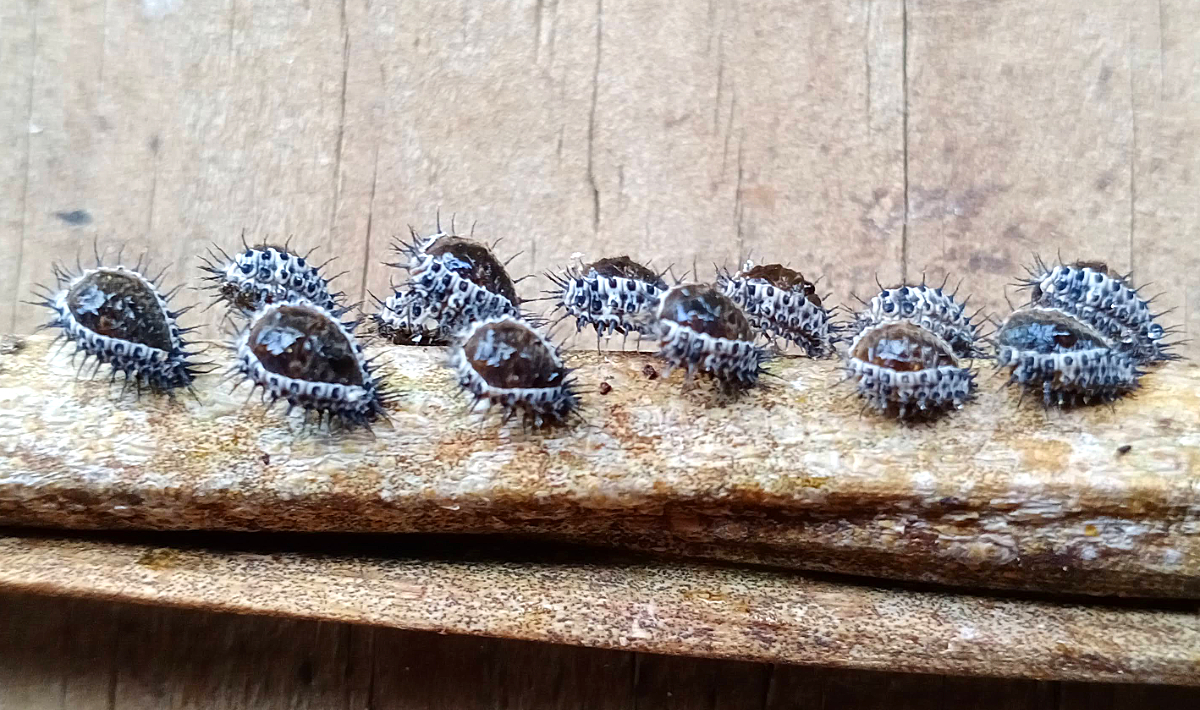
Photo: Scary-looking but helpful! The spiky pupae of the beneficial Red Chilocorus ladybird beetles attached to a dried pawpaw stalk. Both the larvae and adults are helpful in our gardens.
Working in the garden, it is easy to admire the productivity of nature—and, occasionally, to marvel at its sheer cunning. Consider our black ants: tireless, industrious, and surprisingly sophisticated. They understand the principles of food security remarkably well, actively farming mealybugs, aphids and scale insects for their continued supply of sweet honeydew.
Ants will carefully transport these pests from plant to plant like miniature livestock, even fiercely chasing away any predatory ladybird beetles that dare to approach. It is a brilliant strategy for the ants, but disastrous for our crops, as our current ant invasion actively hinders the beneficial ladybirds from doing the job they were brought here to perform.
Many of our beneficial ladybird beetle species were intentionally introduced decades ago as classical biological control agents to combat pests. Today, biocontrol is a highly rigorous science. Strict testing ensures that introduced natural predators target specific pests without causing unintended ecological harm—avoiding the historical mistakes of earlier eras, such as the introduction of Myna birds over a century ago.
When allowed to work undisturbed by ants, ladybird beetles are extraordinarily effective garden allies. Both as adults and during their active larval stages, they consume vast quantities of scale, aphids, and mealybugs. But they do not all look like the classic bright red beetle with neat black spots, nor do they look friendly in their early life stages.
In fact, our local ladybird beetles come in a large variety of disguises. Some are bright orange or vivid red, while others are entirely black, or black adorned with red spots, or some have spots and some do not. To make identification trickier, their larvae and pupae all look downright scary.
Earlier in the year I was shown a dried pawpaw stalk clustered with a lineup of spiky, alien-looking ‘somethings.’ The initial temptation was to assume that anything looking so fierce must be a threat. With spikes like that, surely, it stings or causes some sort of harm. Yet, research and observation revealed a fascinating truth: these were the harmless pupae of the beneficial Red Chilocorus ladybird beetles. Because they look so spiky and strange, there is a natural urge to think ugly equals bad so squish them or reach for a spray. But in doing so, we would destroy the very creatures fighting for our plants.
There is, however, one notable exception to the rule: the 28-spotted ladybird beetle. Unlike its predatory (eats other insects) relatives, this invasive species is a strict herbivore. Recognisable by its duller orange coat, larger size (up to 7mm), dense covering of small dark spots, and an orange/tan underside. Both the adults and larvae scrape away at the foliage of nightshades and staples like kūmara, eggplant, and tomato, leaving behind skeletonised, lace-like leaves.
Gardening successfully means taking a moment to understand the nature around us. To help tell the good guys from the one bad (Henosepilachna vigintioctopunctata), browse photos of recorded species on the Cook Islands Natural Heritage Trust database: naturalheritage.gov.ck/search/results?taxon=1229-coccinellidae.
Before crushing an unfamiliar creature, take time to identify it first. Our tiny predatory friends are hard at work, but they need our help—and our protection from farming ants and squishing fingers—in order to help us.