It is that time of year again when migratory humpback whales return to the warm waters of the Cook Islands.
These remarkable ocean travellers migrate approximately 8,400 kilometres north from Antarctica to the tropical waters of the South Pacific, where they mate and give birth before beginning the long journey south to their feeding grounds.
Humpback whales are not only magnificent to witness, but also important contributors to healthy marine ecosystems. As they move through different ocean depths, they redistribute nutrients throughout the water column, supporting plankton growth and other marine life. They also contribute to the ocean’s natural carbon cycle through their feeding and biological processes.
To raise awareness of these important marine mammals, Te Ipukarea Society and Cook Islands Whale Research delivered a two-day educational experience for Year 7 and 8 students from Araura College. The activity was delivered through the GROW Aitutaki ‘Te Taunga o te Moana’ programme.
The sessions were led by Nan Hauser, Director of Cook Islands Whale Research, who has dedicated 29 years to studying humpback whales in the Cook Islands. Her research has explored their migration patterns, changes in population abundance, and the distinctive calls and songs used by these extraordinary animals.
Students learned about whale characteristics and behaviours, including breaching, surfacing, tail slapping and pectoral fin slapping. They also discovered how whales navigate vast ocean distances using environmental cues such as the sun, moon phases, the Earth’s magnetic field, underwater sounds and seafloor depths.
A key message was that the Oceania humpback whale population remains endangered. South Pacific populations were severely depleted by commercial whaling, including extensive Soviet whaling operations during the 1950s.
Although humpback whale numbers have shown signs of recovery since commercial whaling was largely stopped, they continue to face serious threats. These pressures include reduced food availability due to the overfishing of krill in Antarctica, ocean pollution, unregulated whale watching tourism and warming ocean temperatures, which may alter the abundance and distribution of their food.
Emerging activities such as deep-seabed mining could create further risks. Underwater noise from mining operations may disrupt whale communication, behaviour and migration, while secondary sediment plumes could place additional pressure on vulnerable marine ecosystems.
Nan Hauser’s whale-tracking research has shown that some humpback whales visiting the Cook Islands continue westward towards American Samoa, an area identified as having potential for future deep-sea mining. Industrial activity along these migratory pathways could create additional hazards for whales travelling thousands of kilometres between their breeding and feeding grounds.
“Humpback whales connect the Cook Islands to the wider Pacific and remind us that our ocean is one interconnected ecosystem. Protecting them means safeguarding their breeding areas, feeding grounds and the migratory pathways linking these habitats. By giving young people opportunities to learn directly from researchers and experience whales in their natural environment, we are hoping to grow a generation that values our ocean and will speak up for its protection,” said Alanna Smith, Director of Te Ipukarea Society.
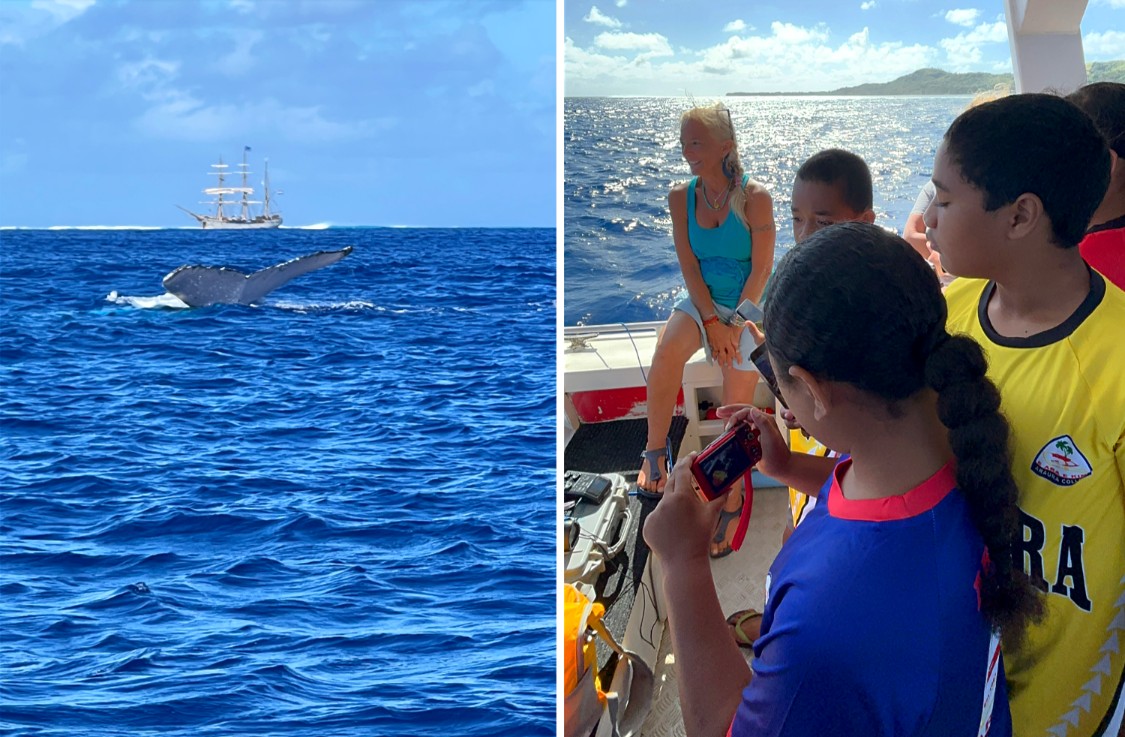
Following their classroom learning, the students travelled beyond the reef to observe humpback whales in their natural environment. They witnessed one whale surfacing and releasing powerful breaths through their blowholes.
One of the most memorable moments was hearing a humpback whale’s song through a hydrophone, an underwater microphone used to listen beneath the ocean’s surface.
Nan Hauser explained that it’s the male humpback whale that produces songs lasting approximately 17 to 20 minutes. The males sing songs to attract females, and sing as a form of competition, to show dominance over their territory. These songs can change year after year and it’s believed this is because the whales pick up new songs along their migratory route, a way to share unique messages with one another, messages we can’t even decipher yet.
There is still much to learn about humpback whales, their migration and their contribution to ocean health. Continued research, education and responsible marine management will be essential to ensuring these magnificent animals can safely return to Cook Islands waters for generations to come.
A big meitaki atupaka to the New Zealand High Commission for supporting this initiative through GROW Aitutaki and helping provide young people with meaningful, hands-on learning experiences that connect them with the ocean and the remarkable species that call it home.
Nan Hauser’s published research on Cook Islands humpback whales can be found through Google Scholar.