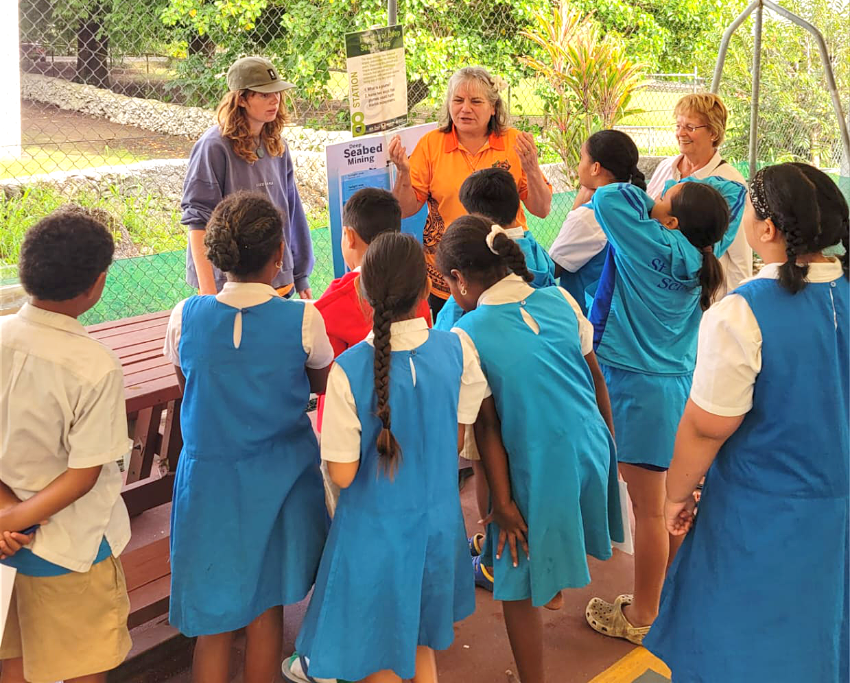
Photo: June Hosking and Gemma Langley present on the impacts of sedimentary plumes
Tere Apii‘anga, meaning “a learning journey”, has brought ocean education to most schools across Rarotonga, encouraging students to explore the connections between a healthy ocean, healthy communities, and the wellbeing of future generations.
Delivered under the banner of Ocean Ancestors, the initiative brought together Kōrero o te ‘Ōrau, Ocean Toa, and Te Ipukarea Society, combining their knowledge, experience, and perspectives to create an interactive learning journey focused on ocean health and wellbeing.
Across eight stations, students explored traditional fishing practices, coral reefs, wetlands, marine baseline monitoring, diel vertical migration, underwater sound, plastic pollution, and the impacts of sediment plumes from deep-sea mining. Activities included demonstrations, games, storytelling, experiments, and practical challenges designed to make complex environmental issues understandable and relevant to young people.
Each station contributed to a wider message: the ocean is not separate from everyday life. It is connected to culture, food, family, climate resilience, and community wellbeing. Following is a summary of student reflections and take away learnings.
Traditional fishing activities encouraged students to consider the ocean as a living system with which people build relationships, rather than simply a source of resources. Students learned about rā‘ui, traditional fishing methods, and the importance of taking only what is needed. Their reflections showed that these lessons had prompted deeper conversations about respect, restraint, and responsibility.
Students were equally fascinated by the hidden systems that keep the ocean healthy. Many were surprised to discover that corals are living animals and that reefs provide habitats for fish while helping protect coastlines. Others learned for the first time that wetlands and pa‘i taro act as natural filters, cleaning water as it moves from the land towards the lagoon. By describing wetlands as the “kidneys of our lagoons”, students recognised that decisions made on land can directly affect the health of the reef.
The learning journey also introduced students to processes occurring far beyond what can be easily seen. They discovered that billions of small marine organisms undertake diel vertical migration each day, moving between deep and surface waters while circulating nutrients and transferring carbon through the ocean. Through sound-based activities, students experienced how deep-sea animals rely on sound and vibration to navigate, communicate, find food, and locate one another.
These activities helped students understand that disturbances in one part of the ocean can have consequences throughout an entire ecosystem.
Plastic pollution and deep-sea mining prompted particularly strong responses. Students learned that plastics originate from fossil fuels and can break down into microplastics that remain in the environment, threatening lagoons, marine species, and food sources. They also explored how disturbing the deep seafloor could create sediment plumes and other impacts within ecosystems that have remained largely undisturbed for millions of years.
The reach of Tere Apii‘anga extended further on its final day, when a group of approximately 12 students from Takamoa Theological College joined the learning journey. Their participation added another dimension to the programme, demonstrating that learning about ocean health is relevant across all ages, educational settings, and areas of community life.
Importantly, the reflections showed that students were not only remembering information. They were carrying it home. Many said they would tell their families not to stand on coral, to protect wetlands, avoid overfishing, reduce plastic use, and keep rubbish out of the ocean. Others captured the learning journey in a simple but powerful conclusion: everything is connected.
The Ocean Ancestors partners extend their appreciation to the hosting schools – Apii Nikao, Apii Avarua and Apii Papaaroa, and to all participating schools, teachers, students, families, volunteers, and supporters who welcomed and contributed to Tere Apii‘anga. Their enthusiasm demonstrated the value of learning that is culturally grounded, scientifically informed, practical, and engaging. President of Te Ipukarea Society, June Hosking said, “We hope the seeds planted through Tere Apii‘anga will continue to grow and help nourish a generation of critical thinkers who question, connect, and act, while cherishing the natural resources around them.”
We also extend our thanks to misereor for having a vision for a better world and financially backing us to run this event.