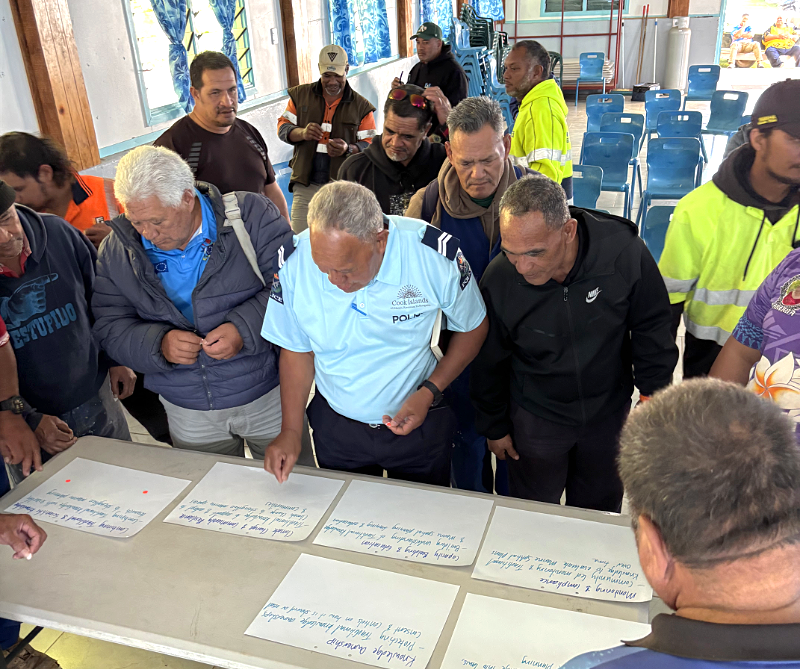
Photo: Participants from the Mangaia Traditional Knowledge and Marine Spatial Planning Workshop engage in interactive activity to highlight values that guide us in the Traditional Knowledge Marine Planning space.
Traditional leaders, government agencies, non-government organisations and community representatives have been coming together over recent months to explore how Traditional Knowledge (TK) can help shape the future of Marine Spatial Planning (MSP) in the Cook Islands.
Workshops held in Rarotonga and Mangaia have provided an opportunity to discuss how TK and MSP can work together to support the long-term protection and sustainable management of the Cook Islands’ marine environment.
One important theme emerging from the discussions is whether Traditional Knowledge should provide the overarching framework for marine management, with government legislation and scientific research serving as complementary tools that strengthen, rather than supersede, the customary knowledge, values and practices that have sustained Cook Islands communities and their oceans for generations.
Participants have also highlighted that Traditional Knowledge extends well beyond the reef. For instance, we have expert navigators and fishermen who hold generations of knowledge about ocean currents, seamounts and offshore environments.
The workshops have highlighted that there is currently no single definition of Traditional Knowledge across the Cook Islands. Its meaning and interpretation can differ between islands, communities and individual knowledge holders. Developing a shared understanding of TK will therefore be an important step in ensuring it is appropriately and respectfully incorporated into future marine planning.
Another strong message was that successful marine management depends on people as much as policies. While legislation such as Marae Moana provides the legal framework for marine management, customary systems such as rā’ui remain highly effective in communities where traditional practices are strong, particularly in the Pa Enua. Participants also discussed the challenges on Rarotonga, where community-led environmental management can be more difficult, resulting in some initiatives being led by NGOs and the private sector.
How Traditional Knowledge is accessed, shared and recorded is another important consideration. Mangaia provided valuable insight into the need for consultation processes to reflect local customs. Participants emphasised that meaningful consultation should involve each of the island’s three punas — Ivirua, Oneroa and Tamarua — as each has its own customs and approaches to Traditional Knowledge. Discussions are more comfortably and appropriately held within the respective puna.
The next round of discussions will take place in Aitutaki this week. Two workshops will be held: Monday 24 August, 6pm at Tautu for fishermen and lagoon operators, and Tuesday 25 August, 12pm at Ureia Hall for government representatives, community workers and elders.
The Traditional Knowledge and Marine Spatial Planning project is coordinated by Te Ipukarea Society, SPREP, Ocean Science New Zealand, the National Environment Service, Marae Moana and the Climate and Biodiversity (CaB) Smart Programme.