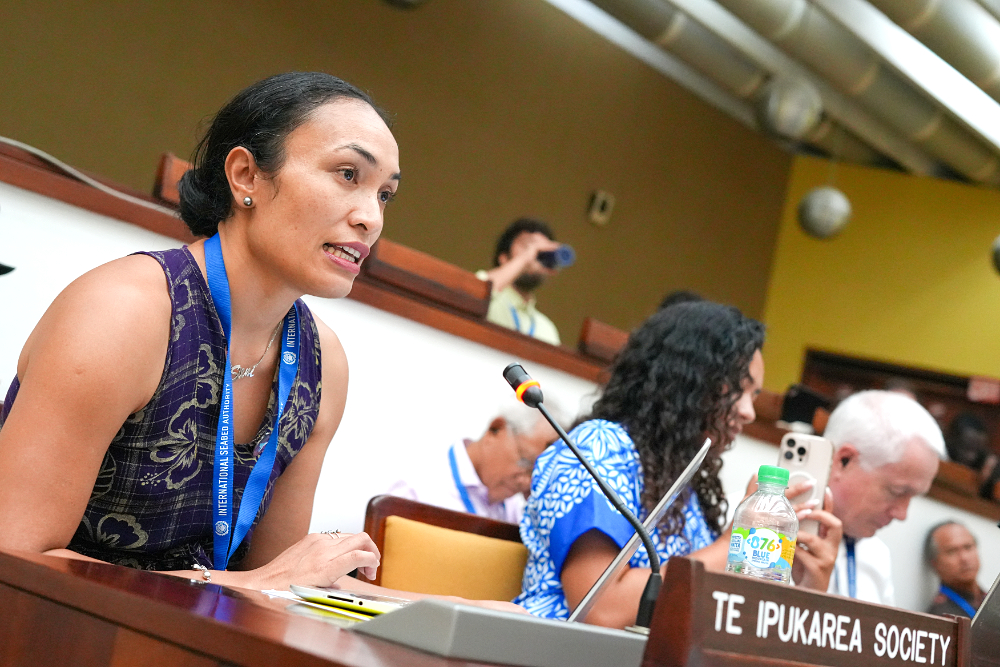
Photo: TIS was represented by Sieni Tiraa who delivered an intervention opposing an attempt by United States company American Deep-Sea Minerals Inc. to obtain an exploration licence from the United States Government for seabed mining activities.
Te Ipukarea Society (TIS) has taken Cook Islands concerns about deep-seabed mining to the international stage, speaking at the recent 31st Assembly of the International Seabed Authority in Kingston, Jamaica. A place where governments, civil societies and industry all gather together to discuss the future governance of the deep ocean in the high seas.
TIS was represented by Sieni Tiraa who delivered an intervention opposing an attempt by United States company American Deep-Sea Minerals Inc. to obtain an exploration licence from the United States Government for seabed mining activities. The area they applied to explore is in the South Penrhyn Basin, within the Eastern High Seas Pocket. This area is an enclave of international waters surrounded by the maritime borders of the Cook Islands, Kiribati and French Polynesia.
The application has been made to the United States Government’s National Oceanic and Atmospheric Administration (NOAA), rather than through the International Seabed Authority (ISA) The ISA is the body established under the United Nations Convention on the Law of the Sea (UNCLOS) to regulate mineral-related activities in the international seabed area for the benefit of humankind as a whole.
The Cook Islands public should be aware of this issue because, although the proposed mining area may sit outside national waters, it is still part of the wider ocean region that Pacific peoples depend on. The Eastern High Seas Pocket is considered ecologically important and is a part of a migration corridor for tuna stocks, whales, turtles and other marine species. These species support food security, livelihoods, culture and the wider health of the ocean.
Sieni Tiraa said that “This is not just a technical legal issue happening far away from us. For our people, the ocean is far more than a source of mineral wealth. It is an extension of who we are, and our realities are shaped around our relationship with the ocean.”
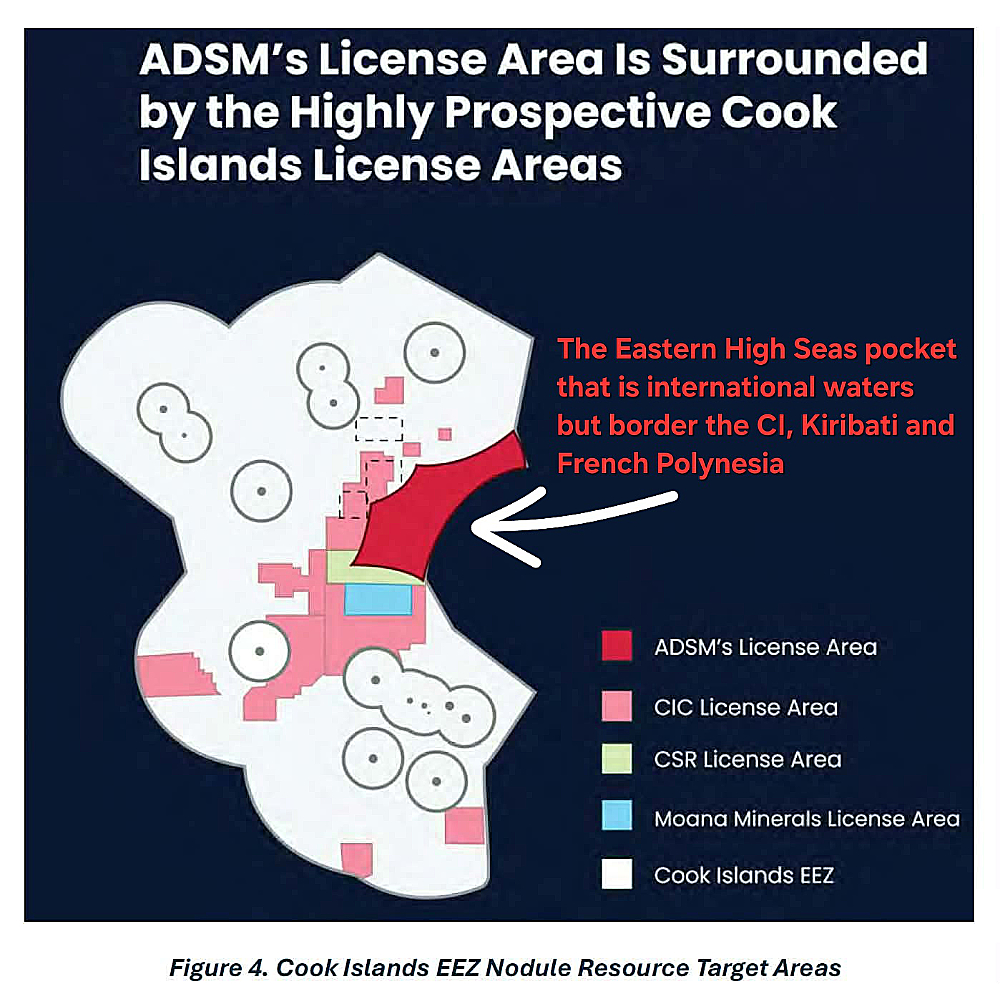
The application raises serious concerns because it seeks authorisation through the unilateral pathway of the United States, rather than through the multilateral, democratic process of the ISA framework that currently has 172 members. At the ISA meeting, the issue of unilateral approval for mining in the high seas was widely discussed, with many states reaffirming that the ISA has the exclusive mandate to regulate deep-seabed mining in areas beyond national jurisdiction. The Earth Negotiations Bulletin reported that many delegates stressed that any unilateral activities fall outside international law and that the ISA’s role under UNCLOS must be protected.
At the ISA Assembly, TIS called for this Eastern High Seas Pocket to be protected instead of being opened to mining. TIS supports the area being considered as a Marine Protected Area under the new BBNJ (Biodiversity Beyond National Jurisdiction) Agreement framework and supports the development of a Regional Environmental Management Plan that recognises the area as an Area of Particular Environmental Interest.
Tiraa said the Cook Islands public should understand that international decisions about the deep sea are linked to national debates and decisions about seabed minerals.
“There is still so much we do not know about the deep sea. Its life, its systems and its role in sustaining the planet remain far beyond our full understanding,” she said. “Deep-seabed mining is not the future we should be rushing toward.”
The intervention at the ISA posed by TIS urged the Cook Islands Government, Kiribati, French Polynesia, the Western and Central Pacific Fisheries Commission and the International Seabed Authority to support protection of the Eastern High Seas Pocket and to oppose unilateral attempts to mine the high seas.
The ocean must be protected as the common heritage of humankind, not treated as empty space for speculative and harmful extraction.