
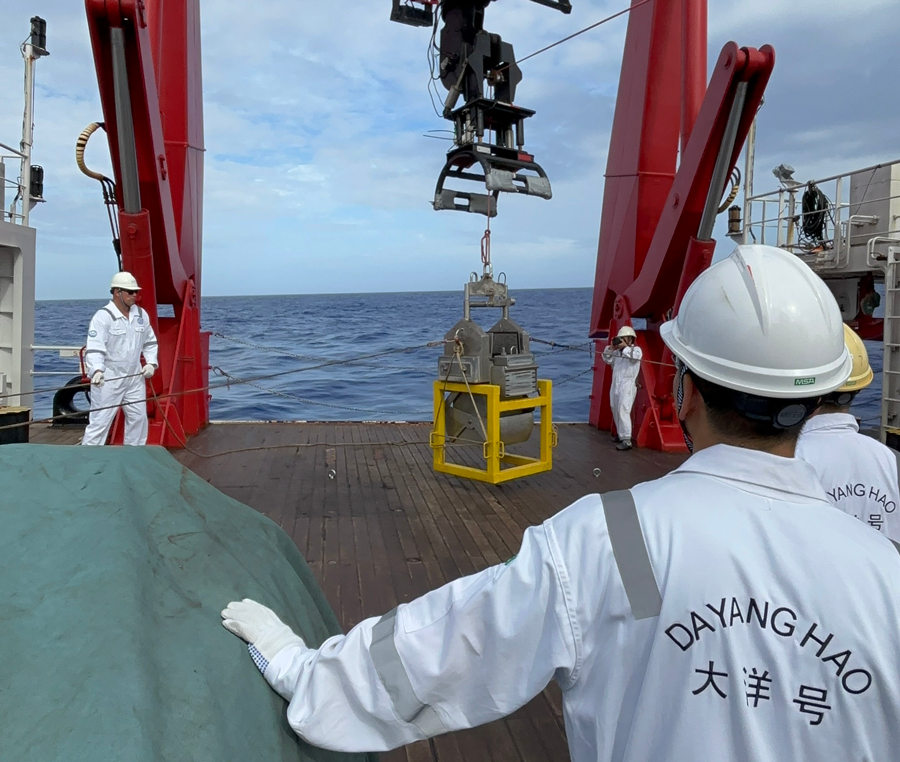
Photo: Chinese research vessel ,Dayang Hao, visited Cook Islands waters in 2025.
The following article incorporates some information from an article written by Elizabeth Claire Alberts Kara Fox, for Mongabay: China’s Deep Sea Mining Fleet May Also Track U.S. Submarines. 24 March 2026 read more on that here. It also draws on Te Ipukarea Society’s own interpretation of the geopolitics involving China and the US and their interest in our deep seabed minerals.
A year-long investigation by Mongabay, in partnership with CNN, has uncovered troubling insights into China’s expanding deep-sea mining fleet, raising questions that extend far beyond resource extraction. The report highlights that what appears to be scientific exploration may also serve strategic and military purposes, highlighting how the race for seabed minerals is increasingly entangled with geopolitics, national security, and environmental risk.
Further scrutiny of vessel behavior revealed patterns consistent with seabed surveillance rather than straightforward mineral exploration. For example Chinese Ships were frequently observed traveling in systematic “lawnmower” patterns typically used for detailed seabed mapping, within strategically sensitive waters near Guam (US territory) and Taiwan whom China have a longstanding sovereignty dispute issue with. Both these locations are widely recognised as critical to global military positioning and maritime security, raising concerns about the true intent behind these missions. In several instances, vessels also disabled their Automatic Identification System (AIS) satellite tracking systems, effectively “going dark” and making their movements difficult to follow. Notably, some of these activities took place near undersea communication cables and known submarine transit routes. These deep sea assets are vital to both civilian infrastructure and military operations.
Concerns about dual-use ocean research are not limited to China. The United States has also significantly expanded its deep-sea research capabilities, with vessels and institutions that operate at the intersection of science, technology, and national security. While often framed as advancing ocean knowledge and supporting conservation, some experts caution that seabed mapping, data collection, and underwater surveillance technologies can also have strategic applications. As global competition intensifies, both nations are investing heavily in understanding, and potentially controlling, the deep ocean environment.
This growing rivalry has direct relevance for Pacific nations, including the Cook Islands. With a massive exclusive economic zone of around 2 million sq.km, and vast deposits of polymetallic nodules, the Cook Islands has become an area of increasing interest for both Chinese and U.S.-linked research efforts. The presence of foreign research vessels, regardless of origin, raises important questions about how “scientific” information gathered in these waters may ultimately be used.
For small island states, the challenge is navigating this complex landscape while safeguarding national interests and environmental integrity. There is growing concern that research conducted under the banner of science, whether by China, the United States, or other global powers may contribute to broader geopolitical strategies that do not always align with local priorities or long-term sustainability goals.
Adding to these geopolitical tensions are the significant environmental risks associated with deep-sea mining. Scientists continue to warn that the fragile ecosystems of the deep ocean are among the least understood on Earth. Disturbances caused by mining activities could result in irreversible biodiversity loss, with recovery processes taking decades, centuries, or potentially never fully occurring.
Ultimately, the Mongabay investigation underscores a critical reality: the race for deep-sea minerals is no longer just about economics or development. It is increasingly a contest for strategic advantage in a largely uncharted domain. For the Cook Islands, this raises urgent questions about who benefits, who decides, and what is at stake if the pursuit of deep-sea resources comes at the expense of both ocean health and national sovereignty.